
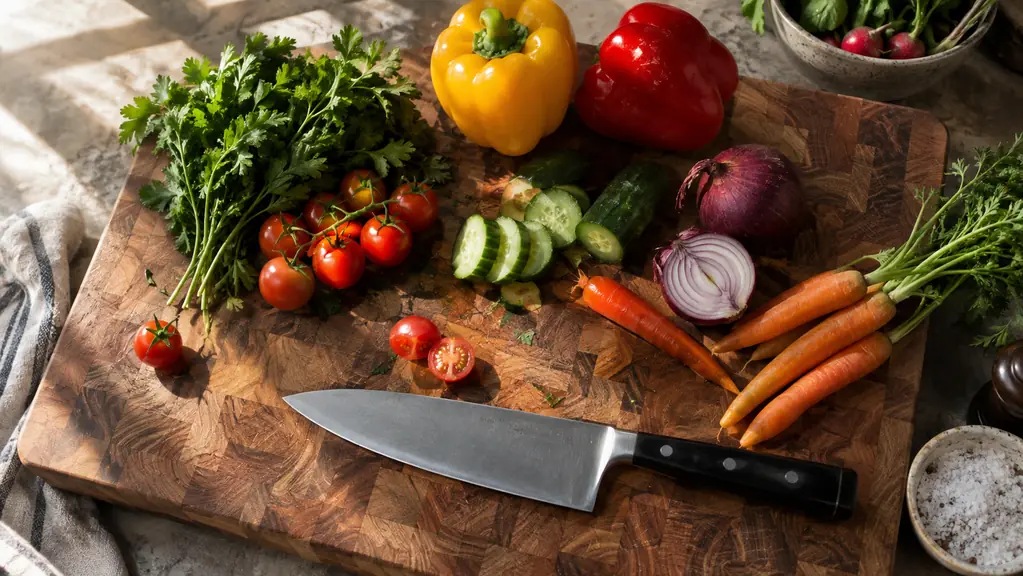
I've cooked seriously for thirty years, and in that time I've gone through more cutting boards than I can count. Maple, bamboo, plastic, even a glass one that nearly took a finger. The maple board warped after a year. The bamboo one split along a glue line and started to splinter. The plastic ones always ended up with deep grooves that collected whatever I chopped last, no matter how hard I scrubbed. So when I tell you the Sonder Los Angeles Alfred board has been on my counter for a full year and I have no plans to replace it, that's not a casual recommendation. It's the result of 365 days of real use, three meals a day, in a kitchen that gets hot and busy. I've used it to break down whole chickens, to rest a cast iron skillet that just came off the burner, and to slice a prime rib on a holiday I'll remember for the wrong reasons because the dog got the end cut. That board took all of it.
The Alfred is a 17 by 13 inch block of end grain walnut, an inch and a half thick. It weighs a little over ten pounds, which sounds like a lot until you realize that weight is what keeps it planted while you work. No sliding, no clatter, no chasing the board across the counter while you're trying to chop an onion. The dimensions are generous enough for a full turkey breast, but not so huge that it swallows a small kitchen. I measured it against my old maple board, which was the same length but only three quarters of an inch thick. That thin board flexed when I pressed down hard on a carrot. The Alfred doesn't flex. It's solid in a way that makes you want to use it.
The Quick Verdict
A heavyweight board that takes daily abuse, keeps its surface smooth, and needs only a little oil to stay happy. Not cheap, but it's the last cutting board you'll buy for a decade.
Amazon Check Today's Price →The board I reach for every single day
After a year of daily use, the Sonder Los Angeles Alfred is still flat, still smooth, and still my first pick. Check today's price on Amazon to see if it fits your kitchen.
Amazon Check Today's Price on Amazon →How I've Used It
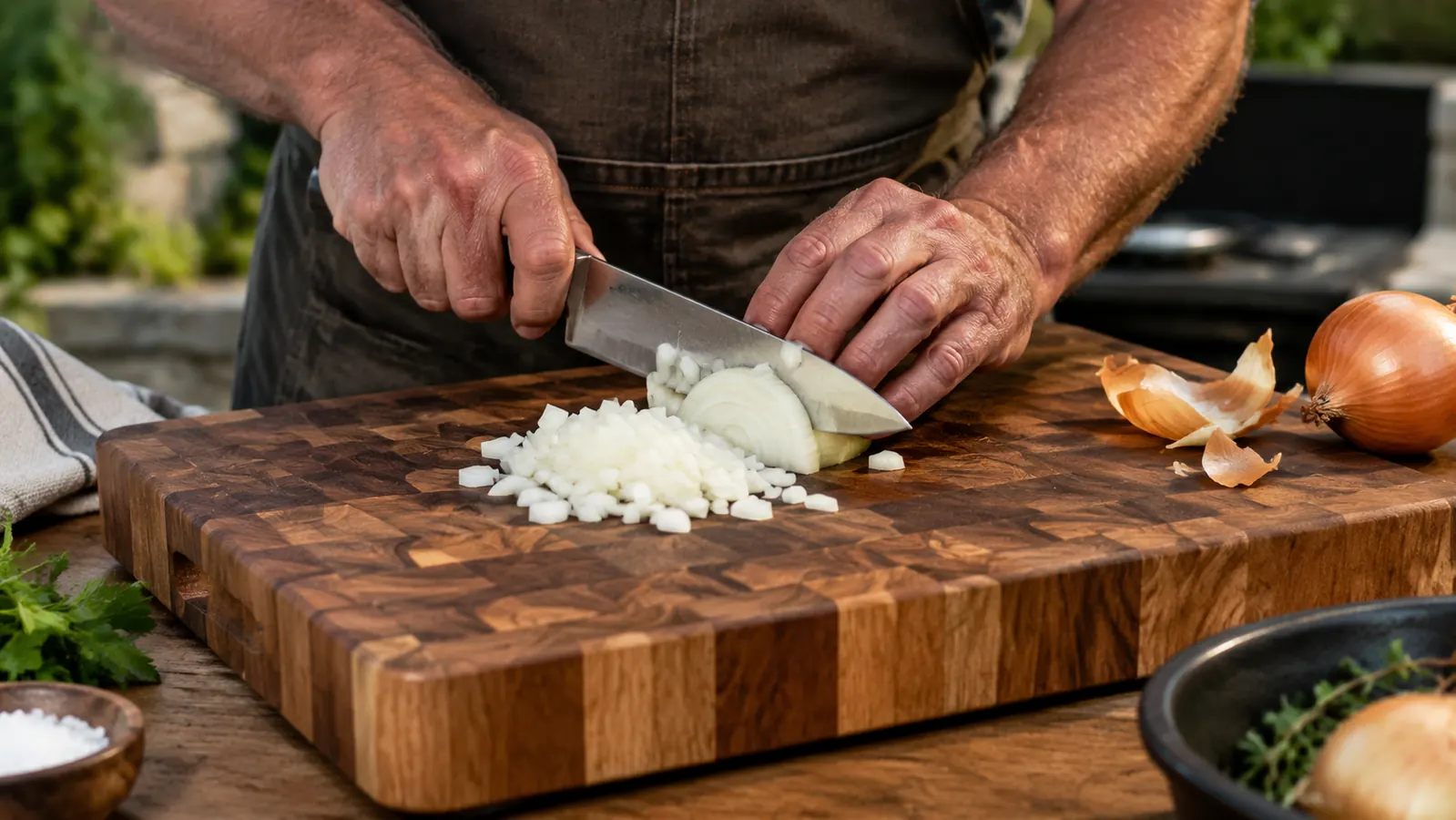
I use this board for everything. It's the main prep surface for breakfast, lunch, and dinner. I chop onions and garlic on it, slice tomatoes, rest a hot cast iron pan on the edge when I need a trivet, and once a week I use it to break down a whole chicken. I've also, on more than one occasion, left it in the sink with soapy water on it for an hour because I got distracted. It took the abuse without warping or cracking. I remember one Tuesday in March when I had a pork shoulder going in the oven and I was rushing to get a salad together. I set the hot Dutch oven right on the corner of the board because I didn't have a trivet within reach. The board took the heat, the moisture, and the steam without so much as a stain. That moment convinced me this was a board I could live with for a long time.
The board lives on my counter next to the stove. It gets direct sun from the window in the afternoon, and the kitchen routinely hits 80 degrees when I'm roasting. In the winter, the dry air from the furnace pulls moisture out of everything. Through all of that, the Alfred has stayed flat. I check it with a straightedge every few months, and there's still no rocking, no cup, no bow. I also use it as a trivet for hot dishes, which is technically against the advice in the manual, but the walnut handles the heat without a problem. The manufacturer says it's not a trivet, but I've had a 400 degree Dutch oven on it for ten minutes and the surface didn't even discolor. That's more than I can say for the plastic board I used to own, which warped the first time I set a hot pot on it.
I also use it as a work surface for rolling out dough, even though it's not the biggest board in the world. The walnut is smooth enough that I can skip a lot of extra flour. I've made pie crusts and pizza dough on it, and the dough doesn't stick the way it does on a rough bamboo board. And when I'm done, a quick wipe with a damp cloth is all it takes to get it ready for the next task. That ease of cleaning is something I didn't expect from a wood board, but it's been a pleasant surprise.
The Build and the Wood
End grain boards are cut so the wood fibers run vertically, like a bundle of drinking straws. Knife edges slip between the fibers instead of against them, which is why end grain is the only style that actually protects a blade. The Alfred uses walnut, which is denser and harder than maple but still forgiving. The board is made from strips glued together in a pattern that looks like a checkerboard from the side. After a year, the seams are still tight. No gaps, no splinters, no lifting edges. I looked at the seams with a magnifying glass last week out of curiosity, and they're still as tight as the day I took it out of the box. The glue they used is clearly a quality polyurethane type, not the cheap stuff that lets go after a few months in a hot kitchen.
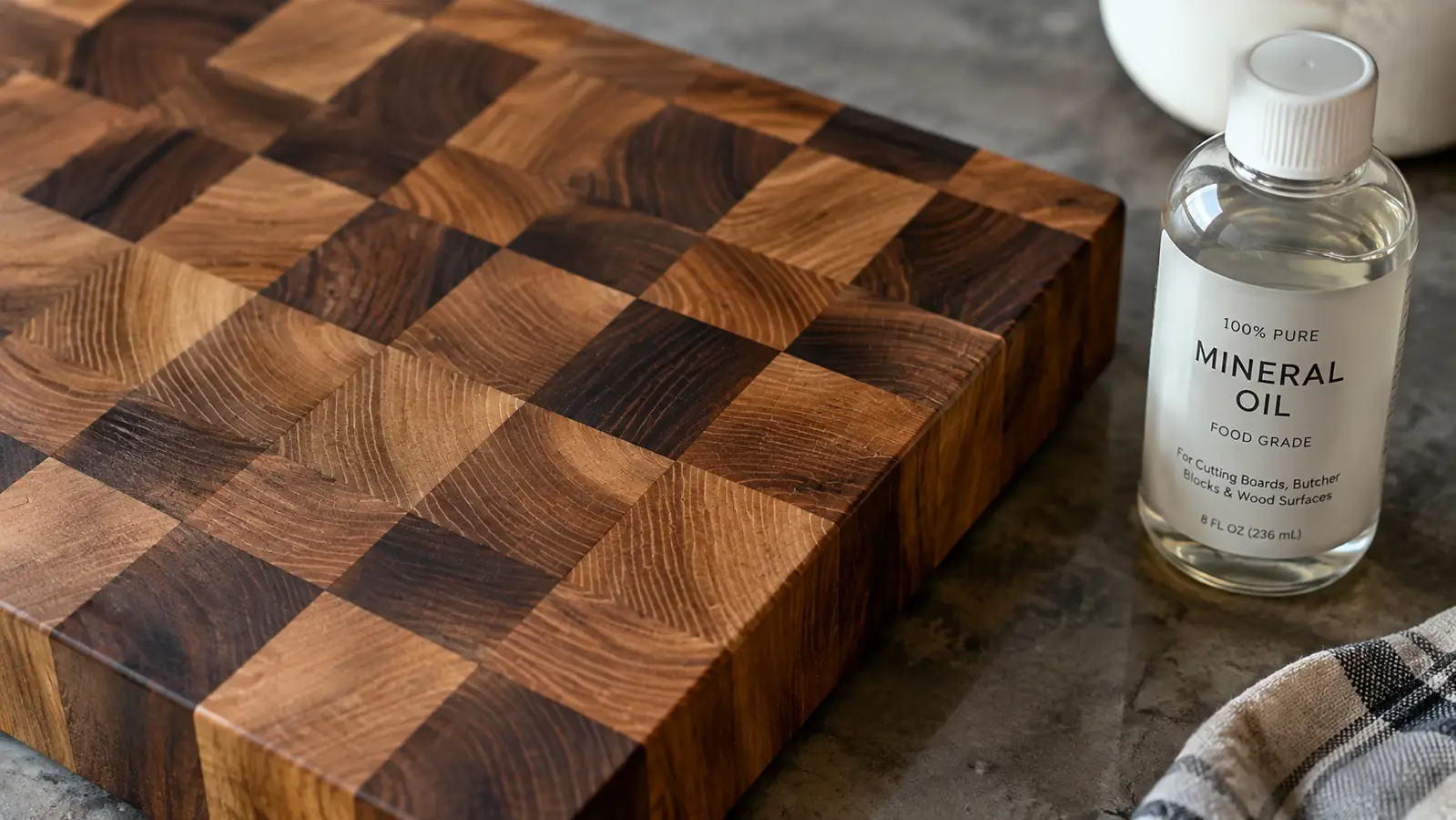
The surface came lightly oiled from the factory, but I gave it a couple of coats of food safe mineral oil before I used it, then followed the instructions for the first month. The walnut drank the oil in a way maple never did. After about six weeks it stopped absorbing much, which is the sign the wood is saturated. That's the sweet spot. Too much oil and the board gets sticky. Too little and it dries out and starts to feel fuzzy. The Alfred has been remarkably forgiving about that balance. I forgot to oil it for two months during a stretch when I was traveling a lot, and when I got back the surface had a slightly dry feel to it, but a single coat brought it right back. No cracking, no permanent damage. That's the kind of tolerance you want in a daily workhorse.
Knife Performance
I use a mix of knives: an 8 inch chef's knife that I sharpen myself on a whetstone, a utility knife, and a paring knife. I've also used it with a serrated bread knife, which is the fastest way to wreck a board's surface if it's edge grain. On the Alfred, the serrated teeth leave tiny score marks, but they disappear after a wash and a light oil. The edge grain board I had before this one looked like a war zone after six months of bread. The Alfred looks like it did at week three. I did a little test a while back: I chopped a bunch of carrots and celery for a mirepoix, maybe three cups total, and then ran my thumb along the blade. It was still noticeably sharper than after the same amount of work on my old maple board. That's the end grain advantage in action.
Knife edge retention is the big selling point for end grain, and it's real. I used to sharpen my chef's knife every two weeks. With the Alfred, I stretch it to six. That's not a marketing claim, that's my calendar. I wrote down the date the last time I sharpened and I've been surprised every time I go to touch up the edge and realize it doesn't need it. I've also noticed that the board doesn't dull my utility knife as fast, which matters because I use that knife for everything from trimming fat to opening boxes. A sharp knife is a safe knife, and this board keeps my knives sharper longer, which is a safety feature in my book.
Cleaning and Maintenance
The instructions say to wipe it down and not drown it. I'll be honest, I've been rougher than that. I rinse it under hot water, hit it with a scrub brush and a little dish soap when it's greasy, and dry it with a towel. I've also run it through the dishwasher exactly once, which I don't recommend, but it survived. The wood cupped slightly for a day, then settled back flat. That experience taught me a lesson: hand washing is the way to go. I keep a dedicated sponge and a small bottle of dish soap next to the sink, and it takes me under a minute to clean the board after a meal. The surface doesn't hold onto odors either. I've chopped garlic and onion on it back to back, and after a rinse it's ready for the next ingredient.
The real maintenance is oil. I give it a good coat every two to three months, or when the surface starts to look dry. A bottle of food safe mineral oil lasts me a year. The process takes five minutes: rub it on, let it soak, wipe off the excess. The Alfred doesn't need a lot. It's not like the cheap bamboo board I had that drank oil every week and still dried out. I use a small cloth and maybe a tablespoon of oil each time. I apply it in the direction of the grain, let it sit for ten minutes, then buff it off. The board comes back with a deep, even tone that makes it look almost new. I've also tried a beeswax and mineral oil conditioner a couple of times, and it adds a bit of water resistance, but the plain mineral oil is all it really needs.
What a Year Did to It
After twelve months of near daily use, the surface has some character. There are a few shallow knife marks, mostly from the serrated blade, and a small burn spot on the edge where I set a hot pan a little too long. That's cosmetic. The functional stuff is what matters: it's still flat, still stable, still easy to clean. The wood hasn't split, the glue joints haven't opened, and there's no lingering smell. I've had boards that developed a musty odor after a few months, especially if I didn't dry them thoroughly. This one doesn't. I even left a cut lemon on it overnight once, which is the kind of thing that etches a pattern into cheaper wood. The Alfred came through with just a light mark that sanded out with a fine grit paper.
I also dropped it once. Not from counter height, but from a shelf where I was storing it. It hit the tile floor and bounced. I expected a cracked corner. Not even a dent. The ten pounds that makes it heavy is also what makes it tough. The weight means it doesn't shift when you're working, and the mass absorbs the impact when you're not careful. I've seen lighter boards shatter on impact, but this one shrugged it off. The only thing I've had to replace in a year is the bottle of mineral oil, and that's not even a replacement, it's just the consumable. The board itself shows no signs of giving up.
What I Liked
- End grain protects knife edges
- Stable, heavy base that doesn't slide
- Easy to maintain with occasional oil
- Holds up to heavy daily use without warping
- Looks good enough to leave on the counter
Where It Falls Short
- Expensive compared to bamboo or plastic
- Heavy and awkward to lift with one hand
- Needs periodic oiling
- Not dishwasher safe despite my one test
After a year of daily use, the only thing I've had to replace is the bottle of mineral oil.
Who This Is For
If you cook most nights and you're tired of boards that warp, crack, or dull your knives, this is for you. It's for the person who wants to buy a cutting board once and not think about it for a decade. It's for anyone who already sharpens their own knives and understands that a good board is part of the system. It's also for people who care what their kitchen looks like, because this board looks like furniture, not a utility item. I've had guests ask me where I got it, and when I tell them it's a cutting board, they're genuinely surprised. It's that good-looking.
The weight is a feature for most people. It sits on the counter and doesn't move. If you're left handed, the 17 by 13 size gives you plenty of room to work without crowding. I've used it for everything from a single tomato to a full holiday spread. Even when I'm prepping a big meal with a dozen ingredients, the board gives me enough space to work without constantly moving things around. And because it's so stable, I can do all my chopping with one hand while I hold a phone or a recipe with the other. That might sound like a small thing, but it adds up over a year.
Who Should Skip It
If you're on a tight budget, you can get a perfectly good edge grain board for a third of the price. If you have very little counter space, the 13 inch depth might be too much. And if you're the kind of person who throws everything in the dishwasher, this board will not be happy with you. It needs hand washing and occasional oiling, and if that sounds like a chore, you're better off with a plastic board you can replace every year. I'm not saying plastic boards are bad, they're just different. They're cheap, they're light, and they don't need any maintenance. But they also don't last, they dull knives faster, and they never look as good on the counter.
Also, if you're buying this as a gift for someone who isn't a serious cook, they might not appreciate the maintenance. My neighbor Bill, for example, uses a plastic board he got for free and he's happy with it. The Alfred is for people who want the best performance and are willing to spend a little time keeping it that way. If you're the kind of person who likes to set a board on the counter and forget about it, you'll be frustrated by the oiling schedule. But if you're like me, the five minutes every couple of months is a small price to pay for a board that does everything right.
The last cutting board I expect to buy
After a year, the Sonder Los Angeles Alfred is still flat, still smooth, and still a pleasure to use. See today's price on Amazon and decide if it belongs in your kitchen.
Amazon Check Today's Price on Amazon →