
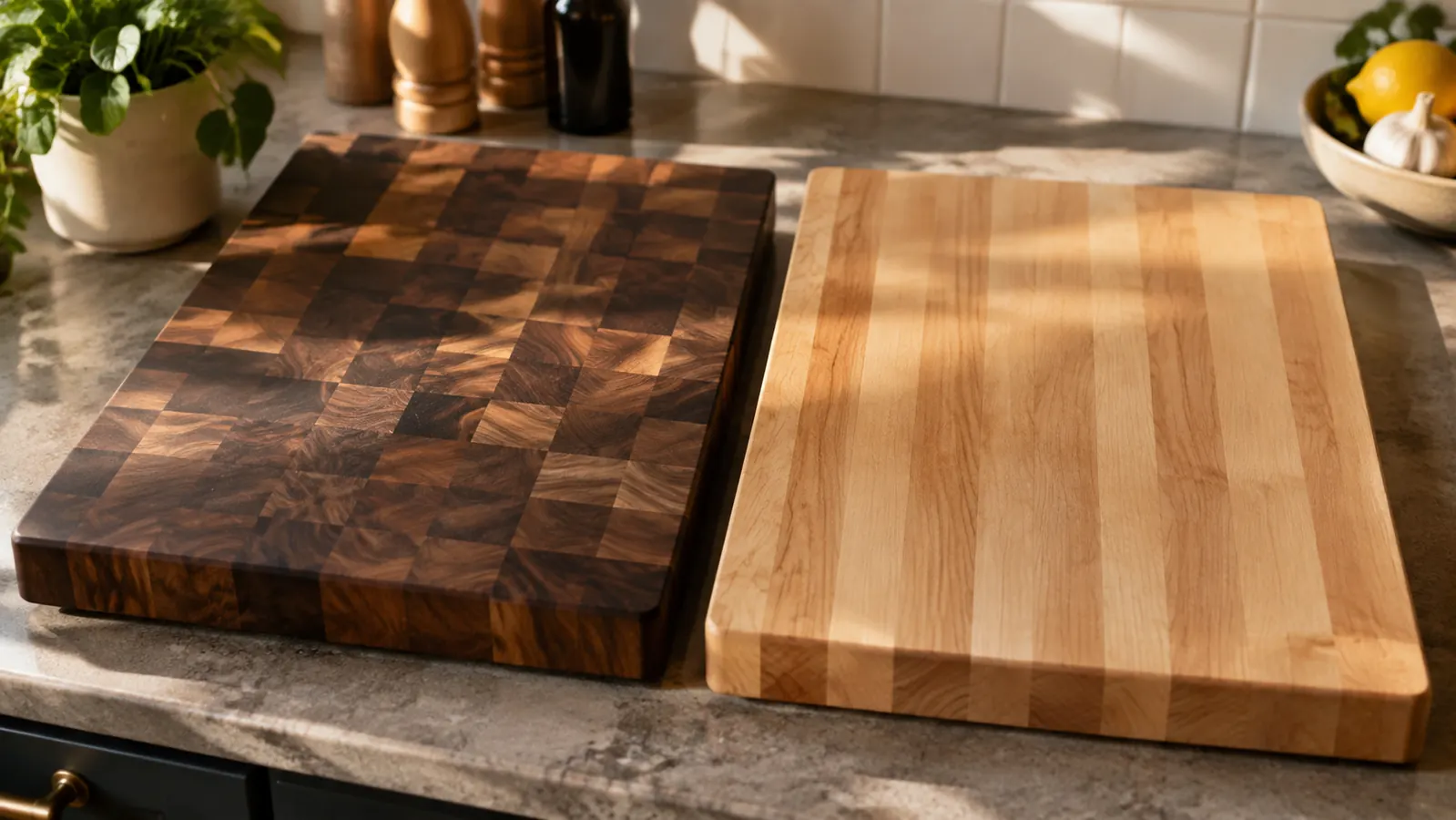
Short answer, because you probably came here for one. End grain is kinder to a knife edge and costs more, both to buy and to look after. Edge grain is cheaper, lighter, needs less attention and will still serve you well for years. If you own knives worth sharpening and you cook most nights, end grain earns the difference. If you do not, it does not, and anybody who tells you otherwise is selling boards.
I have run both on the same counter for the last year. The end-grain board is a Sonder Los Angeles Alfred in walnut, seventeen by thirteen and an inch and a half thick, and the edge-grain one is a maple board about the same footprint that I have had for six or seven years. Same kitchen, same knives, same cook. What follows is what actually separated them.
One thing worth clearing up before the rest of it, because the terms get used loosely. Edge grain and face grain are not the same thing, though they get lumped together. An edge-grain board is built from strips laid on their sides, so what you see and cut on is the long side of the fiber. A face-grain board is a wide plank showing the flat of the board, which looks handsome and is the worst of the three for knives, and those are usually sold as serving boards even when nobody says so. When I compare end grain against edge grain here, edge grain is the sensible everyday board, not the pretty plank.
| End Grain (Sonder Alfred Walnut) | Edge Grain (Maple Board) | |
|---|---|---|
| Effect on knife edge | Fibers stand upright, so the blade parts them and closes behind. Edges last noticeably longer. | Blade cuts across the fiber. Not harsh, but the edge dulls sooner over the same work. |
| Knife marks | Cuts close up and largely disappear. The face stays even for years. | Marks stay visible and accumulate into a scored patch where you always work. |
| Weight | About ten pounds. It stays where you put it and never slides. | Around four pounds. Easy to lift, rinse and move one-handed. |
| Upkeep | Oil every month, board wax a few times a year. Miss it and end grain splits at the glue lines. | Oil every few months. Forgiving if you forget once or twice. |
| Price | Several times the cost of a comparable edge-grain board of the same size. | The value buy, and by a wide margin. |
| Water tolerance | Absorbs more readily. Never soak it and never leave it flat in a wet sink. | Handles a rinse and a wipe with less drama. |
| Feel under the knife | Soft, quiet, slightly giving. You stop hearing the blade land. | Firmer and louder. Perfectly pleasant, just more of a tap. |
| Lifespan if maintained | Decades, and it can be sanded flat and refinished more than once. | Many years, but the scored working area is harder to bring back. |
Where End Grain Wins
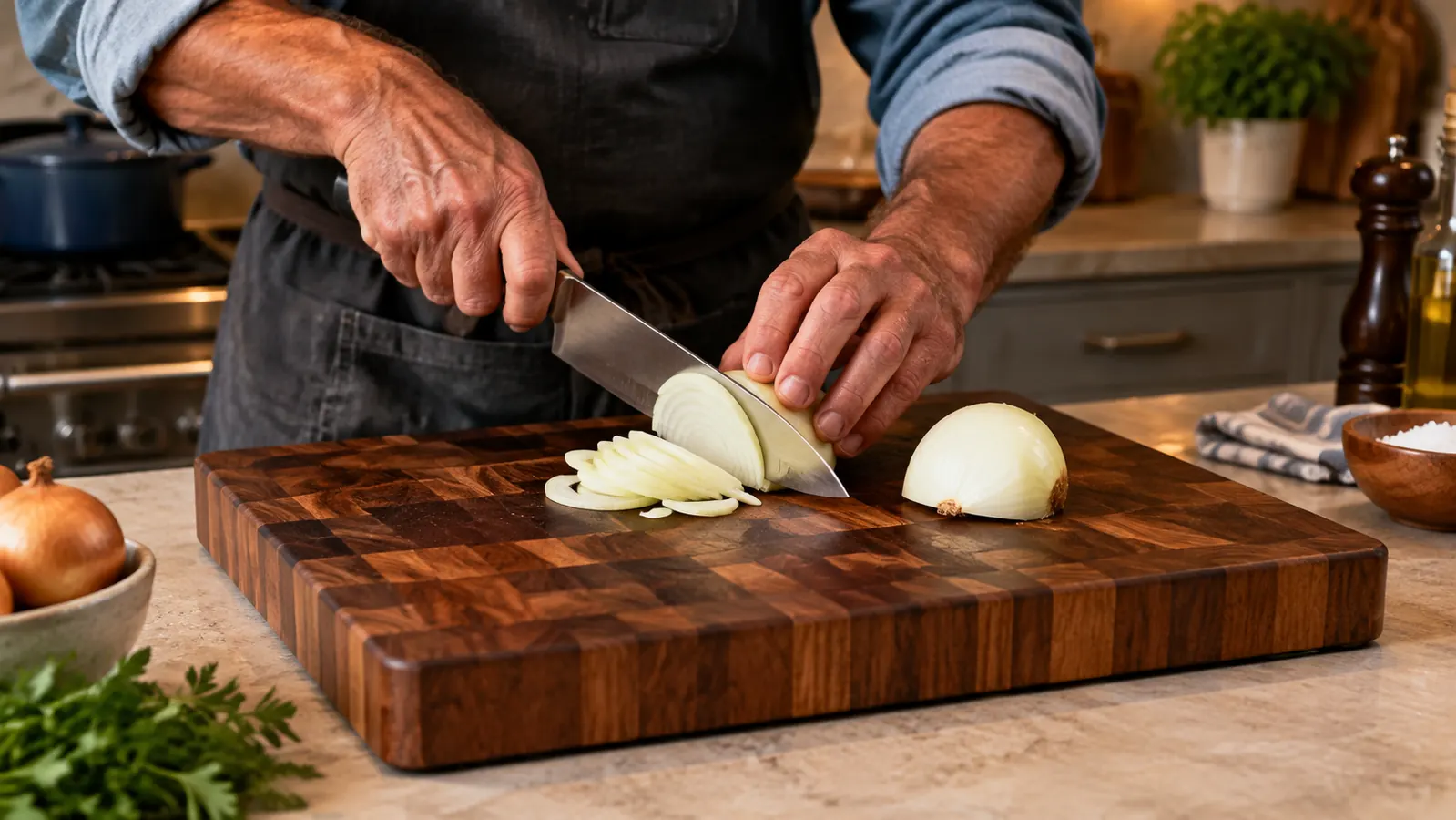
The reason to buy end grain is what happens to your knife, and it is not marketing. In an end-grain board the wood is stood on its end, so what your blade meets is the cut ends of thousands of fibers rather than their sides. The edge slips between them instead of shearing across them, and when you lift the knife those fibers close back up. That is why an end-grain face still looks like a face after a couple of years while an edge-grain board develops a pale scored patch right where you always stand.
I did not believe the knife-life claim until I had a way to test it that was not just a feeling. Last winter I put a freshly stoned chef knife on the end-grain board and used it there exclusively, and I honed it only when it stopped taking a curl off a piece of paper cleanly. It went nine weeks. The following stretch I did the same thing on the maple board with the same knife and the same rough mix of work, and I was reaching for the steel at week six. That is not a laboratory, but it is my kitchen, and a third more time between sharpenings is a real difference across a year.
The other thing end grain gives you is quiet. That sounds like a soft argument until you have done a large prep session on both. The Sonder board takes the knife with a dull thud instead of a click, and there is a slight give at the surface that your wrist notices by the second hour. When I broke down a case of chicken in April, four hours of work, I finished it on the walnut board and my hand was in better shape than it usually is. I would not buy a board for that alone, but it is a genuine part of what the money buys.
End grain also hides its own history better, which matters more than it sounds. My maple board has a rectangle in the middle roughly the size of a sheet of paper where the surface is visibly lower and paler than the rest of it, because that is where I stand and that is where six years of knife work has gone. It is not unsanitary and it does not affect the cutting, but the board is no longer flat there, and a board that is not flat lets a round onion rock while you are trying to cut it. The walnut board has taken a year of the same treatment and I cannot find the spot where I work. I know where it is, and I still cannot see it in raking light.
Where Edge Grain Wins
Weight and price, and neither is a small thing. My maple board is around four pounds, which means I can pick it up one-handed, carry a pile of diced onion to the pot, rinse it in the sink and stand it on its edge to dry without thinking about it. The Sonder board is about ten pounds. Ten pounds is fine on the counter and it is genuinely nice that it never slides, but it is a two-handed object, and rinsing it means holding it at an angle over the sink rather than laying it in there. My wife will not use the walnut board for this reason alone and has said so plainly.
Upkeep is the other place edge grain is simply easier to live with. End grain drinks oil, because all those open fiber ends are effectively a bundle of straws pointed at the surface. Mine wanted oil every month for the first half year before it settled down. Miss that for a season and end-grain boards are the ones that split, because the wood shrinks unevenly and the glue lines between the blocks are where it lets go. My maple board has gone three months between oilings more than once and has never done anything about it except look a little dry.
There is also the matter of what you are willing to be careless with. I will cut a lemon on the maple board and rinse it. I will not do that on the walnut one, because acid and end grain do not get along and because I know what I paid. A board you are slightly afraid of is a board you use less, and a cheap board you use constantly beats an expensive one you keep for good.
Edge grain is also easier to buy well at a sensible price, which is a real advantage when you are not sure what you want yet. The construction is simpler, so a mid-priced edge-grain maple board from a decent maker is usually a genuinely good board. End grain at the bottom of the market is a different story. The blocks have to be cut square and glued under proper pressure or the seams open, and there is a whole tier of cheap end-grain boards that look right in a photograph and come apart in a year. If your budget only reaches the bottom shelf, a good edge-grain board beats a poor end-grain one every time, and it is not close.
The Board That Gives the Edge Back
The Sonder Los Angeles Alfred is end-grain walnut, seventeen by thirteen, an inch and a half thick and about ten pounds of board that does not move while you work. If you sharpen your own knives, this is the surface that makes that work last longer. Have a look at the current price and the size options.
Amazon Check Today's Price on Amazon →
Who Should Buy Which
Buy end grain if you own knives you sharpen yourself and you cook most nights of the week. Those two conditions together are what make the extra money come back to you, in edge life you do not have to restore and in a board face that still looks like new wood in year three. If you have just bought a good chef knife or a proper set of butcher blades, the board is the cheapest thing you can do to protect that purchase.
Size deserves a word too, because it decides more about how a board feels than the grain does. Seventeen by thirteen is enough to break down a chicken without pushing trimmings off the edge, and it is about the smallest I would want for real work. If your counter can take it and you regularly deal with large cuts, going bigger is the upgrade people notice fastest. What you should not do is buy a heavy end-grain board so large it lives in a cupboard, because then you will reach for whatever is on the counter instead, and the board you use is always the better board.
Buy edge grain if you are outfitting a kitchen from scratch, if several people cook and not all of them will follow rules about oil and water, or if the board needs to be something you can lift, rinse and stow without ceremony. A good edge-grain maple board is not a compromise. It is a perfectly serious tool and it will outlast most of what else is in the kitchen.
There is a middle path worth naming, which is what I would tell most people to do if they asked. Keep a good edge-grain board as the everyday surface and add an end-grain board later, once you have decided you care about your knives enough to sharpen them. Bought in that order, neither purchase is wasted, and you find out whether you are the sort of cook who will oil a board every month before you spend accordingly. I did it in the opposite order once, years ago, with a cheap end-grain board that split at two seams inside eighteen months because I did not look after it, and that was the lesson that cost me the least to learn.
My own answer, after a year, is that I use both and I would not give up either. The Sonder board lives out on the counter and takes all the meat and anything that involves a knife I care about. The maple board handles fruit, citrus, quick jobs and anything I would rather rinse than baby. If I could only keep one, at this stage of my life and with the knives I now own, I would keep the walnut and I would grumble about the weight for the rest of my days.
If you are still weighing it, the honest test is not about wood at all. Go and look at how you store your knives and when you last sharpened them. If they live loose in a drawer and the last sharpening was a place that does it while you shop, buy the edge-grain board, spend the difference on one good knife and a stone, and come back to this in a year. If you already hone before you cook and you know what your edges feel like when they are right, the board is the part of that system you have been neglecting, and end grain is the fix.
Cheapest Insurance a Sharp Knife Has
A board is the surface every edge you own has to survive. If you have started sharpening your own knives, moving to end grain is the single change that shows up soonest. See what the Sonder Alfred costs today and which size fits your counter.
Amazon See the Board on Amazon →