
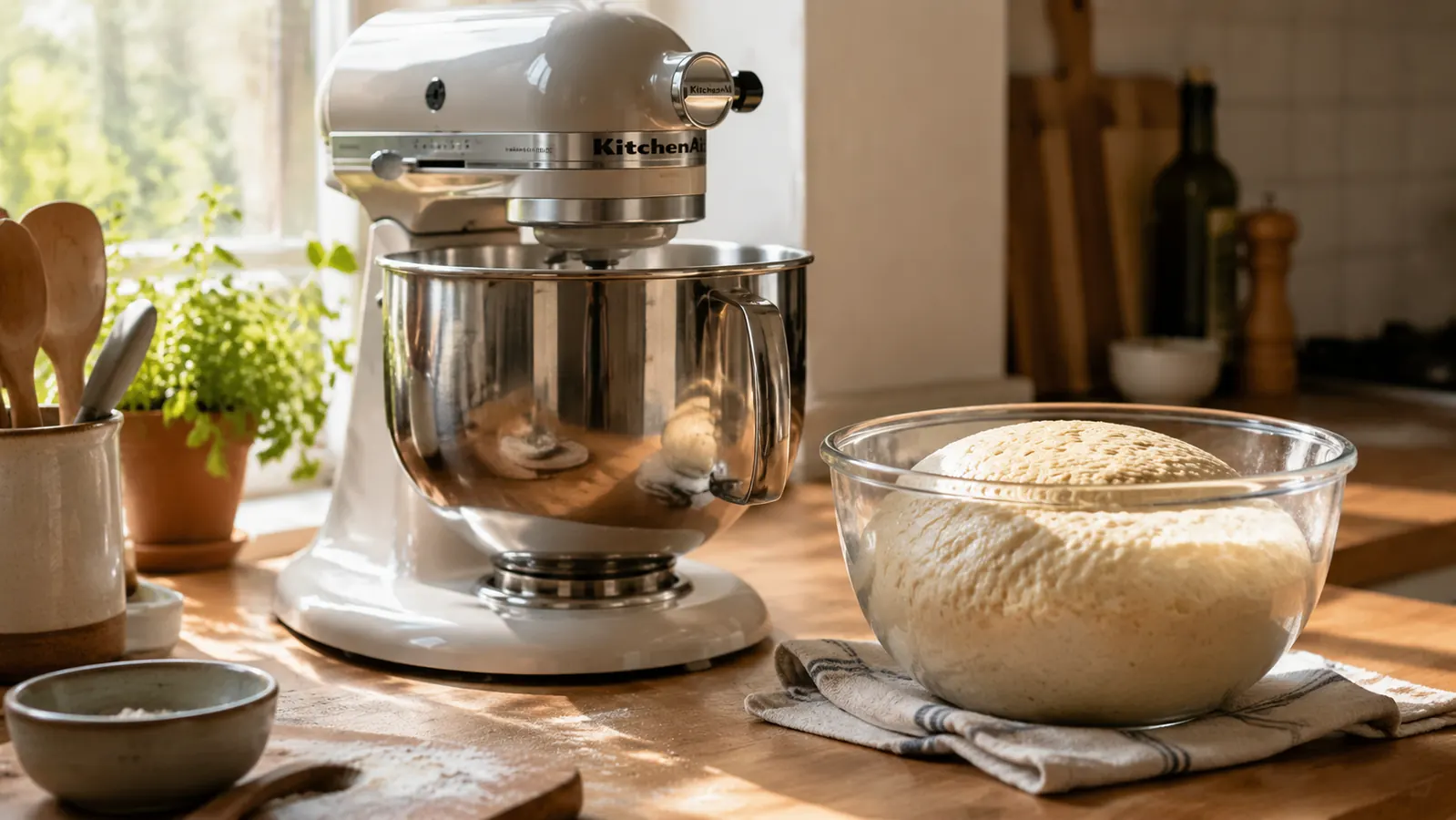
Most people buy a stand mixer for one big holiday baking weekend and then let it sit on the counter as decoration for the rest of the year. I went the other way. I bought the KitchenAid Artisan 5-Quart because I bake bread twice a week and I was done fighting the hand mixer on stiff dough. A year later, it has earned a permanent spot on my counter, and it has also taught me exactly where it stops being useful. That is the part most reviews skip, so I want to start there: what this machine handles without complaint, where the 325-watt motor starts to work, and who should buy a bigger model instead.
I'm Ray Callahan, and I've been cooking seriously for about thirty years. I'm not a pastry chef and I've never worked in a restaurant. I just cook a lot for my family, and my wife does a fair amount of her own baking, so the mixer gets used in this house nearly every day. After twelve months of bread, biscuits, pizza dough and the occasional batch of cookies for the grandkids, I have a clear picture of what the Artisan is and what it isn't.
The Quick Verdict
The best all-rounder for a home baker who kneads weekly but does not need commercial capacity. Just know the motor has limits before you buy, and buy the right bowl size for the batches you actually make.
Amazon Check Today's Price →The mixer I've used daily for a year
If you bake bread, rolls, or anything with stiff dough a few times a week, this is the Artisan to start with. The tilt head makes it the easiest mixer in the KitchenAid lineup to live with.
Amazon Check Today's Price on Amazon →How I've Used It
My routine is simple. Two loaves of bread, twice a week, mixed in the 5-quart bowl. That means roughly four cups of flour per batch, and the Artisan handles that without complaint. I also use it for pizza dough every Friday, biscuit dough on Sunday mornings, and whatever else my wife asks for. When the grandkids come over, it does a double batch of cookies without breaking a sweat, which is more than my old hand mixer could claim.
The most important thing I learned in that first month is to let the machine work at the speed it wants. KitchenAid says to knead on speed 2, and that is not a suggestion. If you try to knead a stiff dough on speed 4 to get it done faster, the whole head rocks and the machine walks across the counter. At speed 2, with the dough hook doing its job, it kneads quietly and steadily, and the dough comes out the same either way.
I also keep a running note of what fails. In a full year, I have never once stalled the motor on a normal bread dough. The only time it labored was a dense bagel dough that pushed five and a half cups of flour, and even then it finished, just slowly and with a lot of head movement. That tells me the limits are real, and they sit right around the four to five cup mark. Everything under that is a non-issue.
The one surprise from the year is how much my wife uses it. She does a lot of her own baking, and she treats the mixer differently than I do. She runs it on higher speeds for cakes and whipped cream, and it handles that work easily. Between the two of us, there are weeks the Artisan runs four or five days in a row, and it has never once complained.
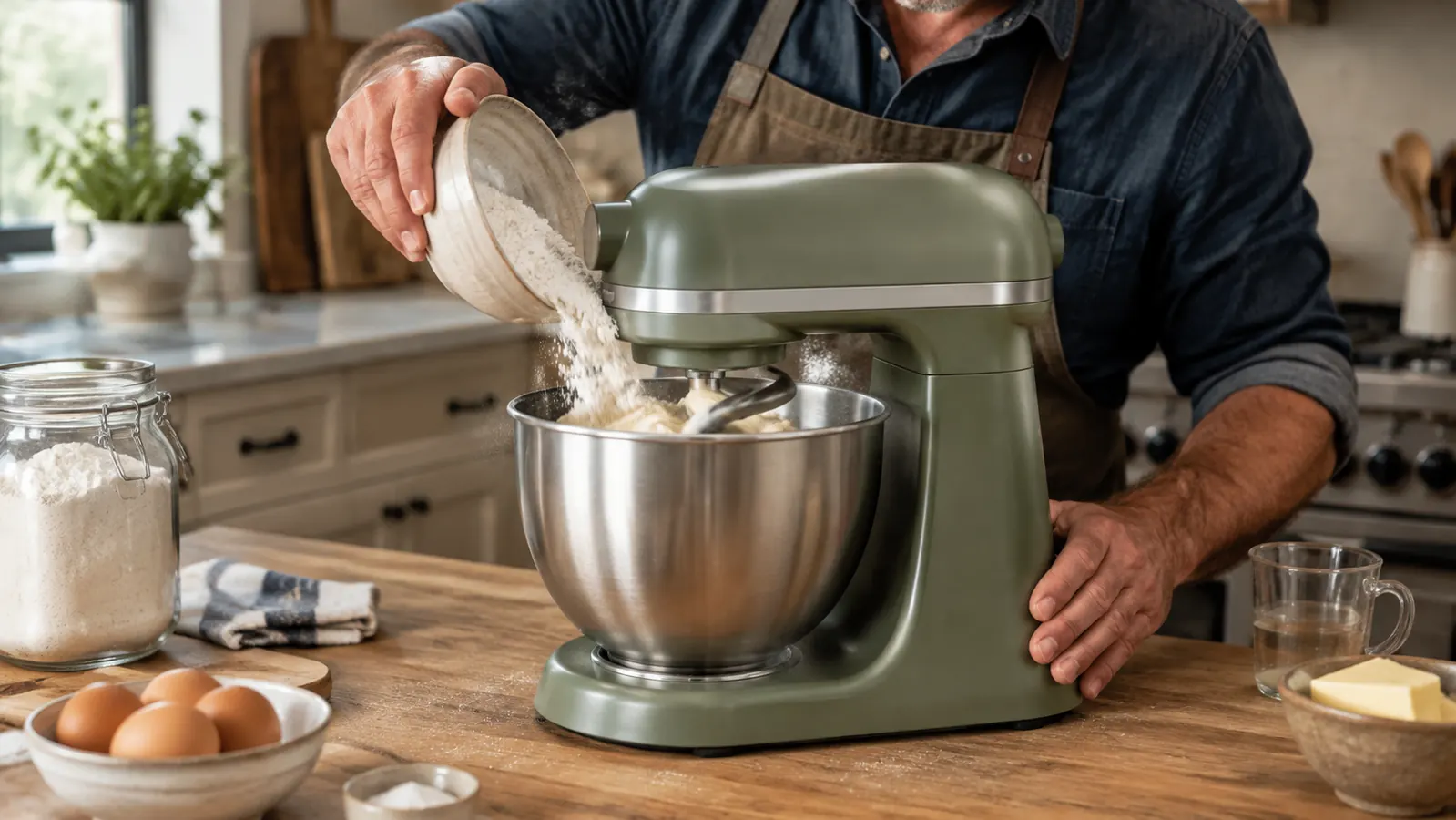
The 325-Watt Motor: Where It Works and Where It Doesn't
The Artisan's motor is the single most argued-about spec on the internet, and most of the argument is a waste of time. What matters is not the number on the box. It is whether the motor can handle the dough you actually make. In my kitchen, the answer is yes for anything up to about five cups of flour, which is a two-loaf bread batch or a generous pizza dough. That covers the baking I do most weeks.
Past that point, the motor starts to work. I can hear it change pitch, the head rocks a little, and the machine wants to walk across the counter. It has never stalled on me, but I would not push it past five and a half cups of flour on a regular basis. If your standard batch is three loaves or a double batch of heavy dough, the Artisan is the wrong tool, and you should be looking at the bowl-lift models with more power. That is not a knock on this machine, it is just a match of tool to job.
The honest way to read this is that the motor is not weak, it is sized correctly for a home kitchen. It is a 325-watt direct drive motor, and it does the job it was designed for. People who complain about it are usually trying to make it do a job meant for a bigger machine, and no amount of wishing makes a 5-quart tilt-head into a 7-quart bowl-lift.
One thing worth knowing is that wattage numbers get thrown around as if they tell you everything, and they do not. A 325-watt motor can feel more capable than a higher-rated one depending on how the gearing is set up. What I can tell you from a year of use is that this motor is matched to the 5-quart bowl it ships with. KitchenAid did not undersize it, and it did not oversize the bowl. The two work together the way they should. And on the subject of speeds, I will add that the ten settings mostly live down at the low end for me. Speed 1 starts every batch so flour does not spray, speed 2 kneads bread, and speed 4 whips cream. That covers nearly everything I do.
The Tilt-Head Design: Why I Chose It Over the Bowl-Lift
The tilt head is the reason I picked this model over the bowl-lift KitchenAid mixers. When the head tilts back, the bowl is completely open. I can add flour, scrape the sides with a spatula, and check the dough without lifting the bowl or fighting a lever. For someone who bakes as often as I do, that convenience is worth more than the extra capacity of a bigger machine.
The tradeoff is that the tilt head has to lock securely, and I have to remember to lock it every time. If you run the mixer with the head up, it makes a horrible racket and you risk the head flipping down mid-run. After a year, the locking lever still clicks clean and holds firm, so the mechanism has not loosened. I check it out of habit now, but it has never failed me once.
One detail I appreciate is that the tilt head gives you full access to the attachment hub at the back of the head. Swapping between the dough hook and the flat beater takes seconds, and cleaning the hub area is easy with the head tilted back. On the bowl-lift models, that area is harder to reach. It is a small thing, but over a year of daily use, small things add up.
What a Year of Daily Use Has Done to It
This is the part I care about most, because I buy kitchen gear to last. After twelve months of near-daily use, the Artisan still runs exactly like it did on day one. No wobble in the head, no stripped gears, no motor noise that was not there originally. The metal body has no dents and the finish has no chips, and I have not been gentle with it. It has lived on my counter through a full year of real cooking.
The honest caveats are worth naming. The wire whip has left fine scratches on the inside of the bowl, and the bowl will not stay showroom-clean no matter what you do. The suction feet on the bottom have also gotten a little less grippy over time, so the mixer slides slightly more on a smooth counter. None of that affects the work it does, but you should know it before you buy so the first scratch does not come as a surprise.
One thing I will add is that the mixer has survived being moved around. I keep it on the counter, but I have hauled it to the table for big baking days and it has been bumped and jostled without any issue. The metal body takes the abuse that a plastic-bodied mixer would not.
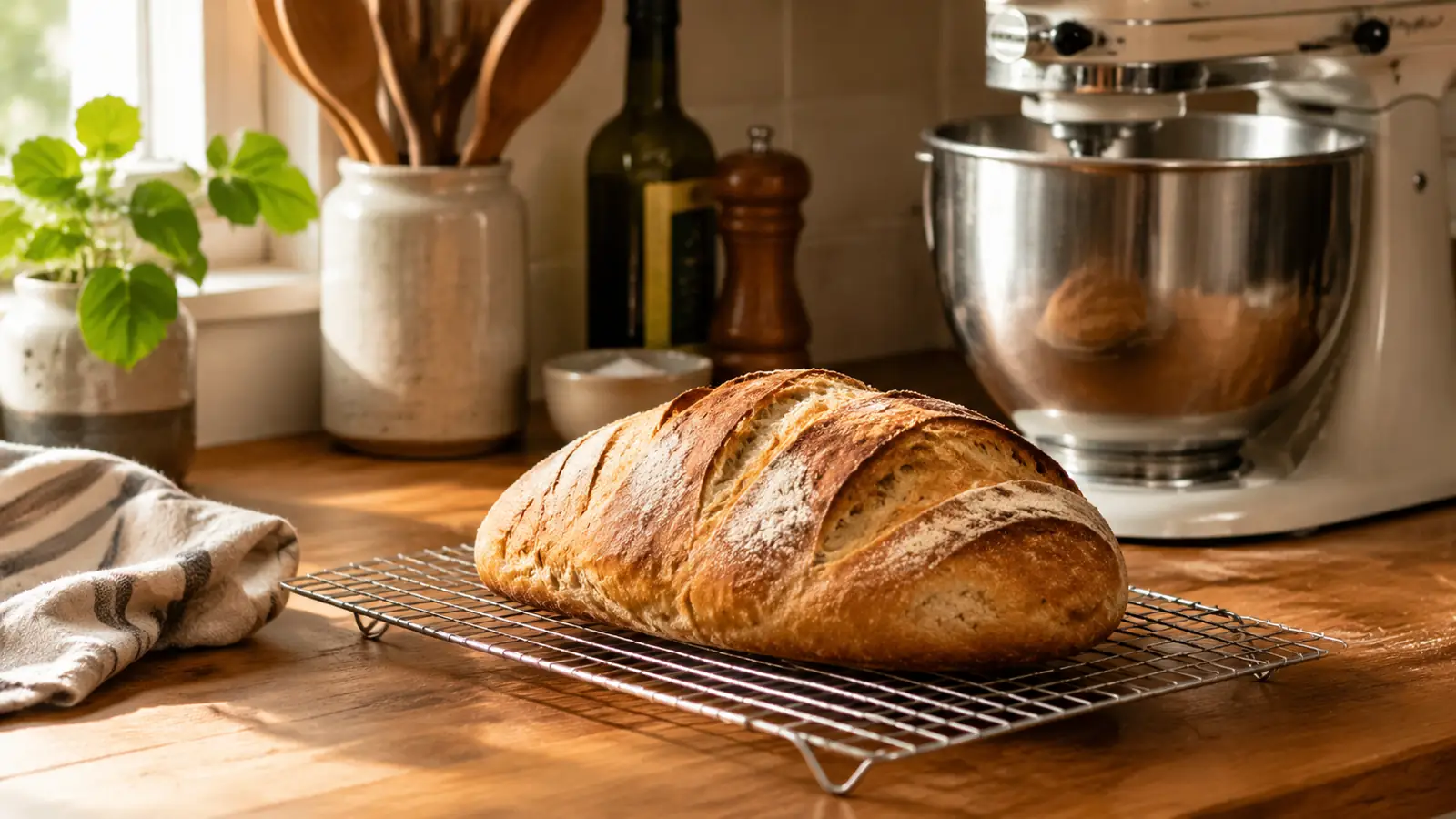
The Bowl, Attachments and Daily Care
The Artisan comes with a 5-quart bowl, a flat beater, a dough hook and a wire whip, plus a pouring shield. The bowl is the right size for a two-loaf bread batch with room to spare, but it gets tight if you try to push a bigger batch. For my twice-a-week bread, it is exactly right. If I baked for a crowd, I would want the bigger bowl-lift model.
The flat beater and dough hook get used constantly and both have held up well. The wire whip is fine for cream and meringue. The pouring shield, though, is the accessory I stopped using after the first month. It does not seal well and it gets in the way when I want to scrape the bowl. My advice is to set it aside and just add dry ingredients slowly with the mixer on low.
Cleaning is simple if you are willing to do it by hand. I rinse the bowl and attachments right after use and hand wash them with warm soapy water. I do not put the attachments in the dishwasher, because the hub where they connect to the mixer can rust, and I do not want to find that out the hard way. It takes two minutes to wash them in the sink.
The base gets a wipe with a damp cloth and nothing more. The one maintenance habit that matters is drying the attachments completely before storing them. A year in, with that routine, everything looks and works like new. Skip the drying step and you will start to see rust on the hubs eventually, so it is worth the ten seconds.
What I Liked
- Tilt head makes adding ingredients and scraping the bowl genuinely easy
- Kneads a standard two-loaf bread batch without complaint
- Stable on the counter once the suction feet are set
- Solid construction; a year of near-daily use with no wobble or stripped gears
- Easy to swap bowls and attachments
Where It Falls Short
- 325-watt motor labors on stiff dough beyond about five cups of flour
- The machine walks on the counter when kneading heavy dough
- 5-quart bowl feels tight for anything over two loaves
- The included pouring shield is more hassle than help
- Wire whip leaves fine scratches inside the bowl over time
A year of twice-a-week bread and the Artisan still kneads a two-loaf batch without a wobble. That is the test that matters.
Who This Is For
The Artisan is for the home baker who actually bakes. If you make bread weekly, roll out pizza dough on Fridays, or bake for a family rather than a crowd, this is the mixer to buy. It is the easiest KitchenAid to live with, the easiest to clean, and it does everything a normal household kitchen will ask of it. That is a rare combination. If you bake once a month for yourself, a hand mixer is fine. If you bake every week for people you feed, the Artisan earns its place.
It is also the right choice if you are upgrading from a hand mixer and you want to buy once. This is not a disposable appliance. With the hand-washing routine I described, I expect this machine to outlast me, and KitchenAid has a reputation for selling replacement parts that keeps these mixers running for decades. That reputation is why I chose it over cheaper alternatives.
Who Should Skip It
If you bake for a crowd, skip it. A 5-quart bowl is tight for anything over two loaves, and the motor will complain on stiff dough beyond five cups of flour. If you regularly make three or four loaves at once, you want the bowl-lift models with a 7-quart bowl and more power. The Artisan is not that machine, and no attachment will make it one.
If you bake twice a year, skip it too. A hand mixer and a little patience will do the job, and you will not get enough use out of a stand mixer to justify the counter space. And if you make very stiff doughs like bagels at volume, the Artisan's motor is not the right tool. Those jobs belong to a heavier machine, and pretending otherwise is how you wear one of these out early. That is not a judgment, it is just honesty about what the machine is for.
A year in, I would buy it again
The Artisan is not the biggest or the most powerful mixer KitchenAid makes. It is the one that does the most real work in a normal home kitchen without getting in the way.
Amazon Check Today's Price on Amazon →