
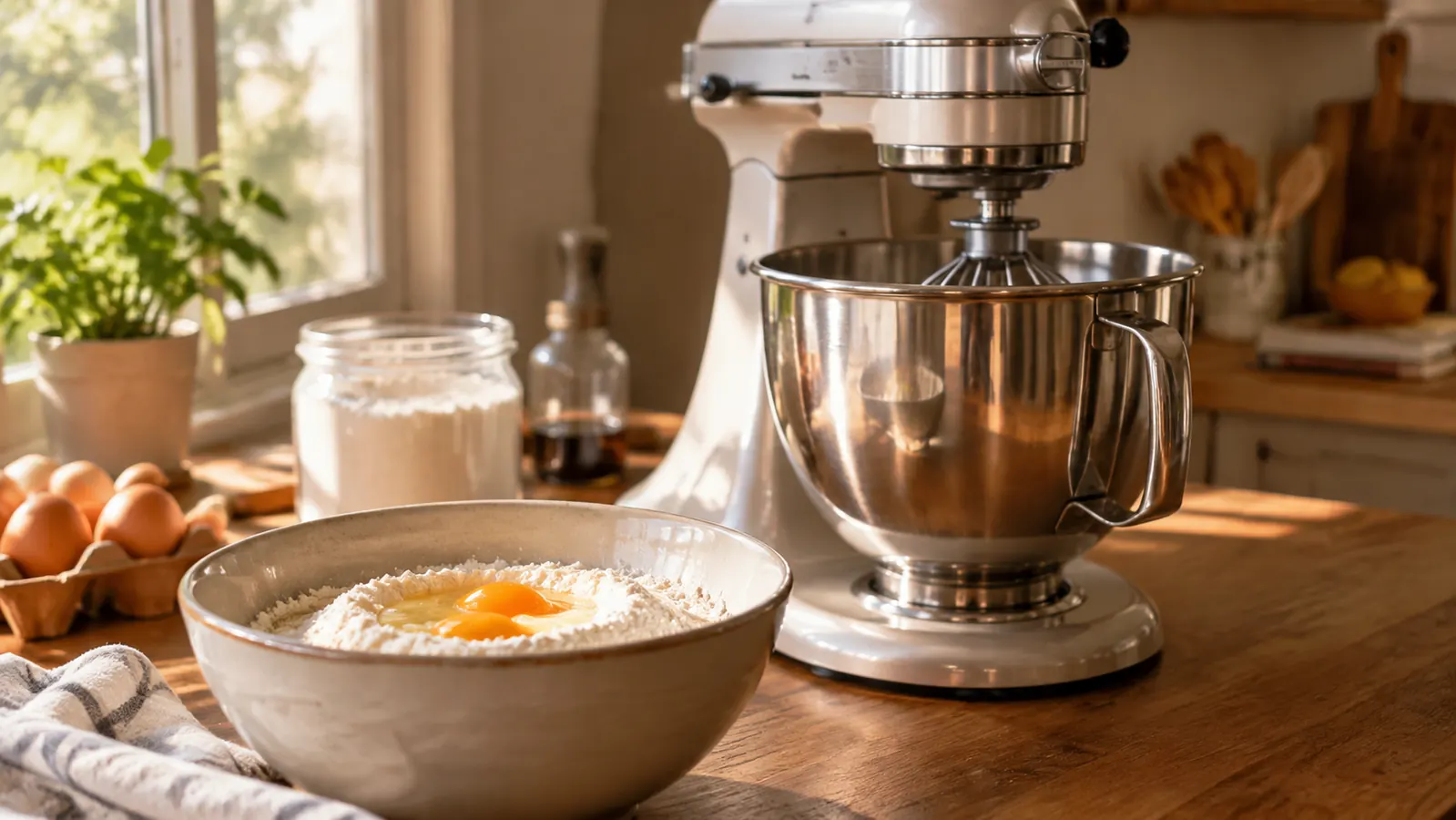
I have had the KitchenAid Artisan on my counter for close to four years now. I bought it after reading the same reviews everyone reads, the ones that call it the only stand mixer you will ever need. I am here to tell you that is not quite the whole story. It is a very good mixer, and I reach for it every single week. It is also heavy, loud on high speed, and genuinely wrong for a few jobs people buy it for. So before you spend your money, here is the honest version. The one that tells you what the Artisan will do, what it will not do, and why I would still buy it again tomorrow.
The short version is this. If your world is cakes, cookies, frostings, whipped cream, and the occasional soft pizza dough, the Artisan is outstanding and will likely outlast you. If you picture yourself kneading stiff sourdough every weekend, stop reading right now and look at the bowl-lift models instead. Most of the disappointment you read about in mixer reviews comes from people who bought the wrong tool for the job. I want to keep you from being one of them.
I am not here to convince you. I have no stake in whether you buy this mixer or any other. What I have is four years of actual use, a counter full of cakes and cookies to show for it, and the memory of the times I pushed it past its limits. You will not find a more honest summary of the Artisan anywhere, because most reviews are written after two weeks with the box. This one is written after four years.
The Quick Verdict
A superb all-round mixer for batters, frostings, and soft doughs. Buy it for those jobs, not for stiff bread dough, and it will serve you for decades.
Amazon Check Today's Price →The mixer most home kitchens actually need
After four years of weekly use, I would still buy the KitchenAid Artisan. See today's price on Amazon before you decide.
Amazon Check Today's Price on Amazon →How I've Used It
I bake a lot. My wife and I have grandkids over most weekends, which means birthday cakes, chocolate chip cookies by the dozen, and a lot of frosting. Before I owned a stand mixer, I did all of it with a hand mixer and a sore wrist. The Artisan changed that overnight. The bowl sits there, the paddle turns, and I can actually walk away and chop onions or prep the rest of the meal while it works. That planetary action, where the beater rotates and also orbits the bowl, gets the sides and the bottom better than any hand mixer I ever owned.
Over four years I have used it for butter cakes, sponge cakes, pound cakes, dozens of batches of sugar cookies, whipped cream, meringues, mashed potatoes, meatballs, and soft dinner rolls. It has made pizza dough maybe fifty times, always at the low end of the speed range. I keep a mental log of what works and what does not, and the pattern has been consistent enough that I feel confident telling you exactly where the limits are.
One note on the bowl. The 5-quart capacity sounds bigger than it is. A standard recipe that calls for three cups of flour fills the bowl past the halfway mark, and once you get to five or six cups of flour you are close to the top. For a normal family that is plenty. The day my daughter asked me to make a double batch of her wedding-cake recipe, I learned very quickly that the Artisan is a single-batch machine. You cannot just double a recipe and walk away. The bowl is full, the splatter shield becomes your best friend, and you are scraping flour off the counter for the rest of the afternoon.
What Nobody Tells You Before You Buy
Let me start with the things I wish someone had told me. First, it is heavy. The base alone is over twenty pounds, and because the head tilts back to release the bowl, the center of gravity shifts when you use it. You will not hurt yourself lifting it, but you will think twice before moving it off the counter. Mine has a permanent home on the counter, and I would plan for that. The Artisan is not a mixer you put away in a cupboard.
Second, it is loud on high speed. On speeds one through four it is a low, steady hum that fades into the background. Push it to eight or ten and it sounds like a small airplane taking off, which is an apt comparison given what I do on weekends. It is not a dealbreaker, because you rarely need those speeds, but if you bake at six in the morning while the house is asleep, you will wake people up. I have done it, and my wife still mentions it.
Third, the tilt head is both the strength and the weakness. It makes getting the bowl in and out effortless, which is why I chose it over the bowl-lift models. But it also means the motor is smaller. The Artisan runs a 325-watt motor, while the bowl-lift KitchenAid Pro models carry around 500 to 590 watts. That difference matters the moment you put stiff dough in the bowl. For batters and soft doughs, you will never notice. For bread, you will. And if you are weighing the Artisan against the smaller Classic, the difference is the same story: a smaller motor and a smaller bowl, fine for light work, short on power for the heavy jobs.
Where the Dough Hook Falls Short
Here is the honest part, and the part the five-star reviews tend to skip. The Artisan is not a bread machine. It kneads, yes, and it does a fine job on soft doughs like dinner rolls, brioche, and focaccia. But stiff bread dough, the kind with sixty percent hydration or less, is too much for the motor and the gearbox over time. The dough hook will grab it, the head will start to climb, and if you are not watching, the whole top of the mixer will walk up the dough until the hook spins free. I have seen it do exactly that.
KitchenAid says to knead bread on speed two, and to keep the dough soft. The company is telling you something real. When I do make bread in the Artisan, I keep the dough on the soft side, I knead in short bursts, and I stop the moment the head starts to strain. For anyone who wants the full picture of what a bread day with this mixer looks like, I have written it out in detail. For serious bread bakers who do two or three stiff loaves a week, I would honestly steer you to the bowl-lift models. They have more power, a stronger gear train, and the head does not climb the way the tilt head does.
None of this is a flaw if you buy the Artisan for what it is. It is a brilliant general-purpose mixer. It is not a heavy-duty bread kneader. The people who complain loudly about the Artisan online are, in nearly every case, people who bought it expecting a bread machine and discovered otherwise. That is a mismatch between the tool and the job, not a defect in the mixer.
The Ten Speeds and What They Are For
The ten speeds are not a marketing gimmick, but they are also not all equally useful. In practice I live on four settings. Speed two for folding and for the dough hook, which KitchenAid explicitly recommends. Speed four for most batters and cookies. Speed six for frosting and whipped cream. And speed ten, very briefly, for egg whites that need real volume. The middle speeds, five and seven, get used maybe once a month. That is fine. The point of having ten is that you can find exactly the speed a recipe wants, and the dial has a positive detent at every setting so it does not drift.
One thing I learned the hard way: always start on speed two and ramp up. If you drop the paddle into cold butter straight from the fridge and hit speed six, you will either fling flour across the kitchen or strain the motor. Start slow, let the ingredients come together, then bring it up. That single habit has probably saved me a trip to the repair shop. It also produces better texture, because you are not beating air into everything before it is combined.
The Accessories Question
KitchenAid sells a long list of attachments for the Artisan: a pasta roller, a meat grinder, a spiralizer, a food grinder, even an ice cream maker. Here is what nobody tells you. The mixer itself is reasonably priced for what it is, and the attachments are not. A single pasta roller costs nearly a third of the price of the mixer. Before you buy the Artisan because you picture yourself cranking out fresh pasta, add up what that actually costs and decide whether a dedicated pasta machine is the better deal.
I own exactly one attachment, the pour shield, which comes in the box, and that is it. I have borrowed Bill's pasta roller once, my neighbor, and it worked fine, but not well enough to make me spend my own money. The meat grinder is solid if you grind your own sausage. The ice cream maker is a fun toy that takes up freezer space. My advice is to buy the mixer for the mixer and add attachments only if a specific job shows up regularly. Most people, including me, never use more than the paddle, the whisk, and the dough hook.

How It Holds Up Over Years
The durability question is the one that matters most to me, because I buy kitchen gear to last. In thirty years of cooking seriously, I have owned exactly two stand mixers, and this is the better one. After four years of weekly use, the Artisan looks and runs like the day I unboxed it. The paint has not chipped, the gears have not stripped, and the tilt mechanism still locks the head in place with the same positive click. I have replaced nothing. The paddle has a small divot where it has bumped the bottom of the bowl a few times, but that is cosmetic and it has not affected a single batch.
The one thing I would tell you is to respect the duty cycle. The Artisan is not meant to run at high speed for long stretches. I run it in bursts, I let it rest, and I never push the dough hook beyond what it can handle. Treat it that way and it will genuinely last decades. I have seen thirty-year-old Artisans at garage sales that still run fine. My father-in-law's KitchenAid is older than my marriage and still going. That is the reputation, and in my experience it is earned.
One honest caution. If you buy a used Artisan, and people do, check the tilt mechanism before you hand over any money. The head should lock firmly and release with one finger. A loose tilt head is the most common failure I have seen on older units, and it is a real repair, not a cosmetic one. Buy new, or buy used from someone who can show you it locks tight. That is the one thing I would inspect twice.
The Artisan is not the mixer for stiff bread dough. It never was. Buy it for what it does well and you will not be disappointed.
What I Liked
- Planetary action scrapes the bowl sides better than any hand mixer I have owned
- Tilt head makes bowl changes effortless with one hand
- Four years of weekly use, zero repairs, zero parts replaced
- Ten speeds with positive detents, no drift over time
- Long list of attachments from pasta rollers to meat grinders
Where It Falls Short
- 325-watt motor struggles with stiff bread dough
- Loud on high speeds, eight and above
- Over twenty pounds, not a mixer you move around easily
- 5-quart bowl is a single-batch machine, no doubling recipes
- Accessories are expensive relative to the mixer itself
The Small Things Nobody Mentions
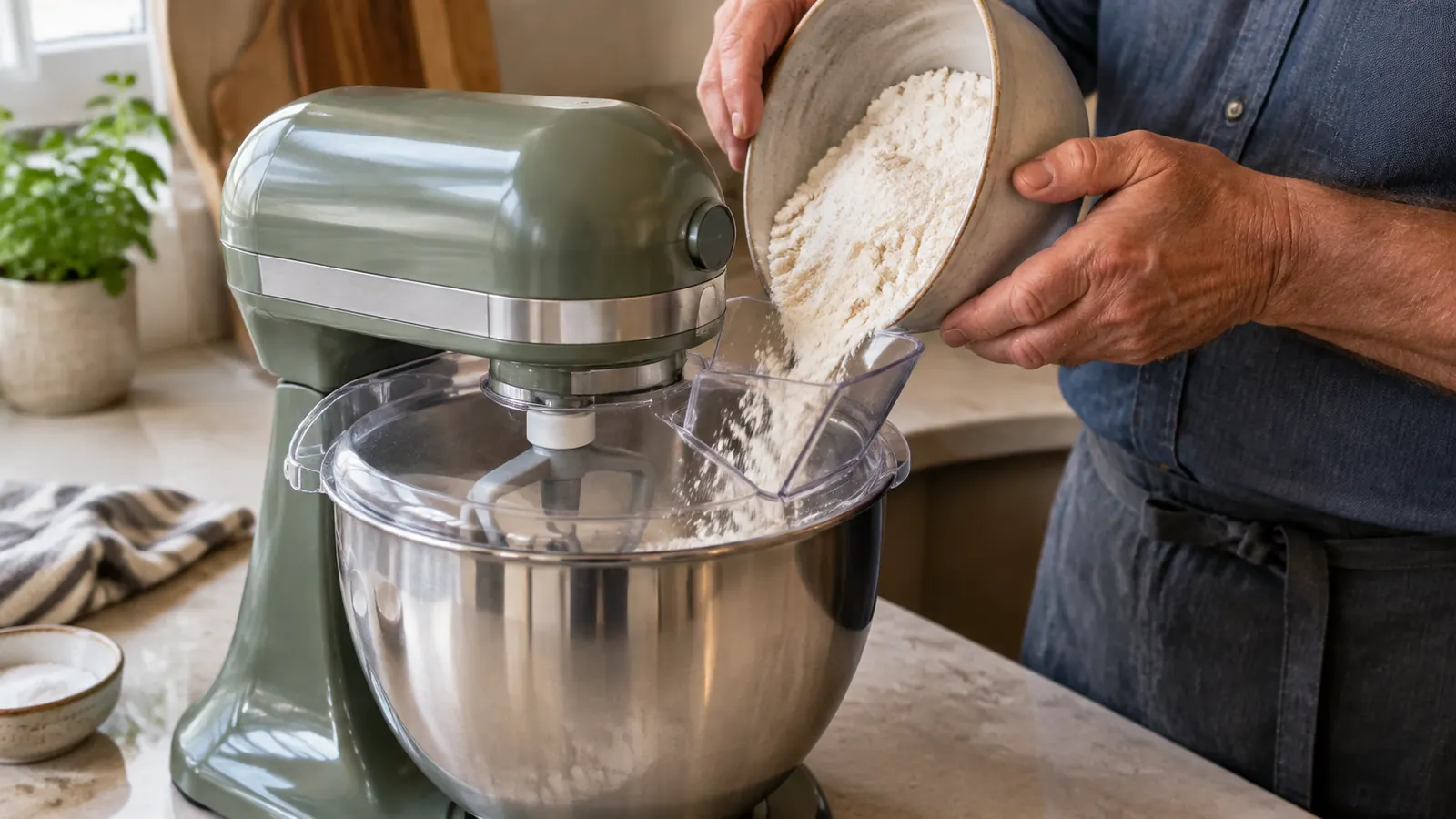
The little details add up in both directions. The bowl handle is comfortable and the bowl seats into the base with a satisfying click. The whisk does a genuinely good job on egg whites and cream, better than I expected, and it cleans up in seconds under running water. The pour shield, which comes in the box, is worth using every time you add flour, because it catches the cloud of powder that would otherwise coat your counter.
On the other side, the attachments all have to be washed by hand, and the bowl is the same. Nothing here goes in the dishwasher. The paddle is a little awkward to clean because of the flat edges. And the machine does walk a little on the counter if you run it at high speed without holding the head, so keep a hand on it when you turn it up. None of these are reasons to skip the mixer. They are just the honest small print that nobody puts in the headline.
And one more detail. The Artisan does a better job than I expected on small batches. You can whip two egg whites in this bowl, which is not true of every big mixer. The tilt head means you can scrape the bowl properly with a spatula, which you cannot do easily with a bowl-lift model. For a household of two most of the time, that flexibility matters more than I thought it would.
Who This Is For
The Artisan is for the home cook who bakes a few times a week and wants one appliance that will never need replacing. If you make cakes, cookies, brownies, frostings, whipped cream, meringues, and the occasional soft dough, this is the mixer. It does those jobs better than anything else at its price, and it does them for decades. It is also the right choice if you want something that feels solid on the counter and looks like it belongs there. My wife and I both reach for it without thinking, and that is the highest compliment a kitchen tool can get. If that describes you, the Artisan is the one to buy, and I say that after four years of living with it.
Who Should Skip It
Skip the Artisan if your real goal is bread. If you knead stiff dough more than once a week, the bowl-lift Pro models are worth the extra money and the extra space. Skip it if you bake in large batches, because the 5-quart bowl tops out at one standard recipe. Skip it if you need a quiet machine for early mornings, because high speeds are genuinely loud. And skip it if you expect the attachments to be cheap add-ons, because they are not. None of this makes the Artisan a bad mixer. It just means the Artisan is a specific tool with a specific job, and the people who are happiest with it are the ones who understood that before they bought it.
Still worth it after four years
I would buy the KitchenAid Artisan again tomorrow for the same money. See today's price on Amazon and decide for yourself.
Amazon Check Today's Price on Amazon →