
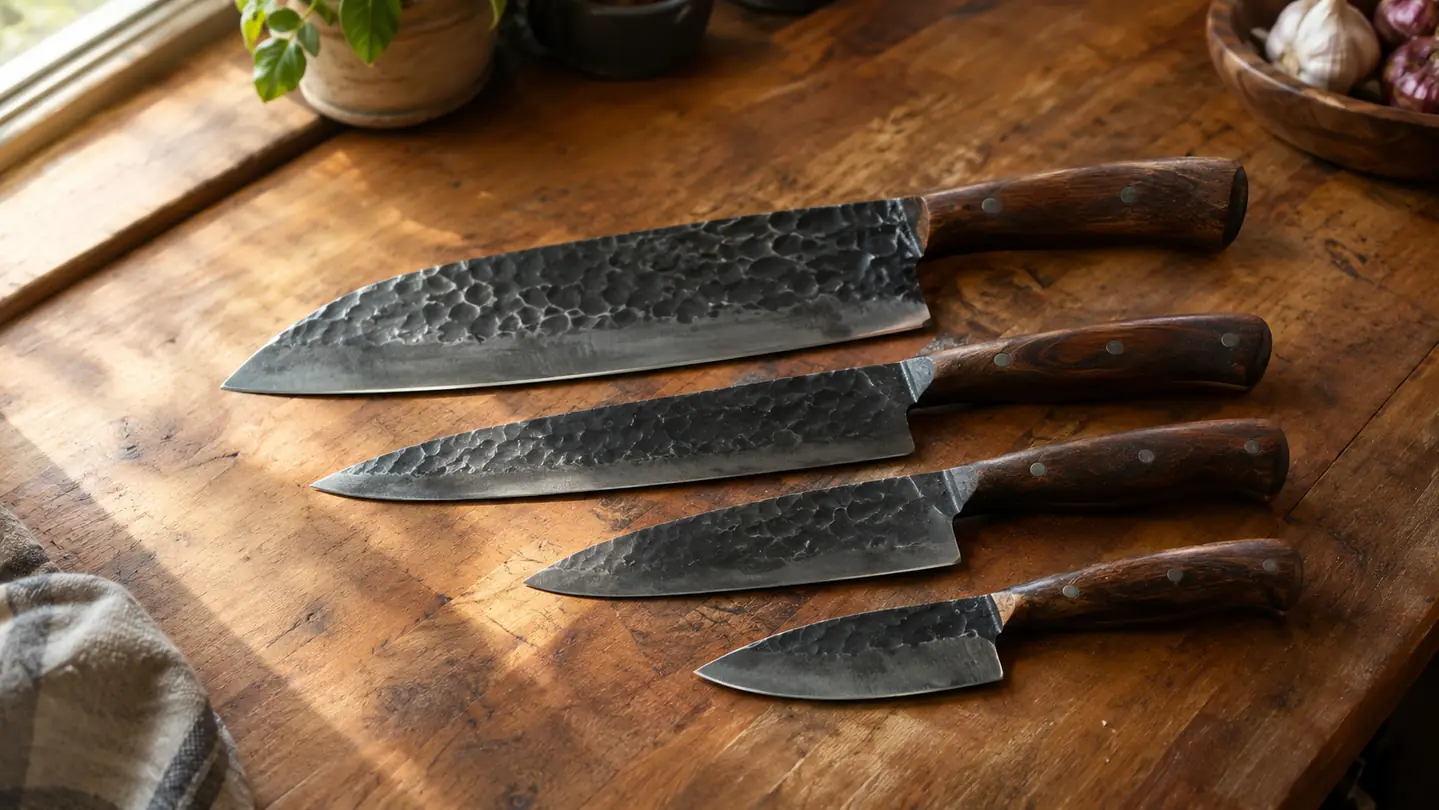
I bought the COOLINA Meat Lover set in January, and for the first three weeks I was the man in the family who would not shut up about his knives. My wife took to leaving the room. That part passed. What I want to write down now, eight months later, is what is left after the novelty wore off, because that is the only part of a knife review that is worth anything to somebody deciding whether to spend real money.
There is a lot of theater around hand-forged knives. The photographs are dark and moody, the copy talks about ancient methods, and none of it tells you what the blade is like on a Tuesday when you have a pork shoulder to break down and forty minutes before you have to leave. So this is the Tuesday version. Four knives, eight months, one home kitchen, no restaurant, no film crew.
The Quick Verdict
These are genuinely good steel and they cut better than anything else I own. They also ask more of you than any knife I have owned, and the asking never stops. Buy the set if you break down whole cuts of meat regularly and you are the sort of person who already dries his tools before he puts them away. If you are not, this is money you will resent.
Amazon Check Today's Price →Four Knives That Cut Like They Mean It
The COOLINA Meat Lover set is four hand-forged high-carbon blades built for meat, not for a display block. If you break down whole cuts at home, this is the set that stops you fighting the job. Check the current price and what is in the box before you decide.
Amazon Check Today's Price on Amazon →How I've Actually Used Them
I buy meat in whole primals when the price is right, which for me is four or five times a year, plus a hog share every fall from a farm about twenty minutes out. Between those, it is chickens most weeks and whatever my son brings back from deer season. So the set does not sit idle, but it also does not run the way a butcher shop runs. Call it once or twice a week of real work and a dozen small jobs in between.
The cleaver is the one that earns its keep. It has enough weight in the front third that you stop chopping and start letting the knife fall, which is a different motion entirely and much easier on the shoulder. I have taken it through chicken backs, pork ribs and the aitch bone on a fresh ham without doing anything I would call effort. The long slicer gets used for exactly one thing at my house, which is cutting cooked brisket and pork across the grain, and it does that in single unbroken strokes instead of the sawing I used to do with a chef knife that was too short for the job.
The two mid-size blades are where the honesty starts. One of them is close enough to the other in length and profile that I could not tell you, without looking, which one I picked up. In eight months I have developed a preference for exactly one of them and the other mostly stays in the drawer. That is not a defect. It is just what happens when a set is assembled to be a set. If somebody sold me three of these knives instead of four, I do not think my kitchen would notice.
The clearest day I can point to was the second Saturday in October, when the hog share came in as two halves and I had the whole thing on the counter at once. That is roughly a hundred and forty pounds of pork to get into the freezer before supper. In previous years that job took me most of a day and ended with my hand cramped around a knife that had stopped cutting somewhere around the second shoulder. This time I worked through both halves in a little over four hours, honed twice in the middle of it, and the last cut of the day went through the belly as cleanly as the first. My wife came out at the end of it expecting me to be in a mood, and I was not.
The Steel Is the Real Thing, and That Cuts Both Ways
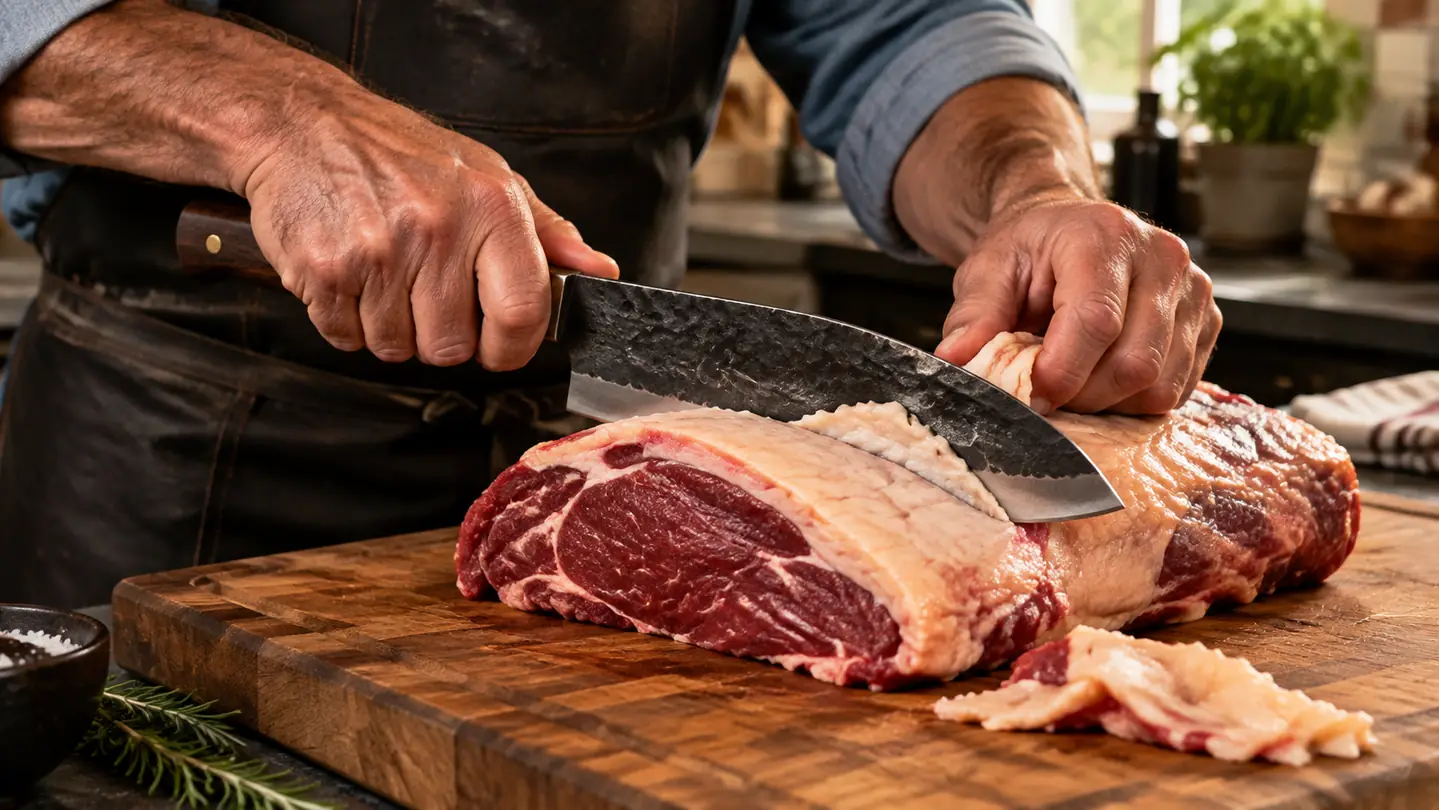
High-carbon steel takes an edge that stainless simply will not, and you feel it the first time you use it. There is a point when you are trimming silverskin off a loin where a good blade stops being a tool you push and starts being a tool you steer. These do that. I trimmed a whole beef tenderloin in March in about a third of the time the same job used to take me, and the trim came off in long clean sheets instead of the ragged strips I was used to.
The other side of that steel is that it rusts. Not slowly and not politely. I left one of the mid-size blades on the board with a smear of tomato on it while I answered the phone, and by the time I came back, maybe fifteen minutes, there was a grey bloom on the steel where the acid had sat. It scrubbed off with a cork and some baking soda, but the finish there is a shade different now and it always will be. That happened once, in month two, and it taught me more than any care card in the box.
What you get in return for that vigilance is a patina, which is the dark uneven skin the steel grows on its own after a few months of use. Mine came in blotchy and I did not care for it at first. By month five it had evened out into something closer to gunmetal, and it does genuinely slow the rusting down. But you should know going in that these knives will not look in year two the way they look in the listing photographs. Nobody tells you that, and it bothers some people a great deal.
There is a smaller thing about carbon steel that took me a couple of months to notice. For the first few weeks it will leave a faint metallic taste on anything sharply acidic that sits against the cut surface, most obviously with tomatoes and with onions that are going into something raw. It fades as the patina comes in and by month three I could not detect it at all, but in February my daughter noticed it on a plate of sliced tomatoes before I did. If you do a lot of raw acidic prep, use a stainless blade for that and keep these for meat, which is what they were built for anyway.
A good knife does not make you a better cook. It just stops the tool from being the reason the job went badly.
Sharpening Is a Skill You Will Have to Acquire
I hone before most sessions and I put the set on stones about every six weeks. That is more attention than my old block set ever got, and it is the single biggest thing I would want somebody to understand before buying. Hand-forged carbon takes a beautiful edge quickly, which is the good news, and it gives that edge up faster than a hard stainless blade would, which is the rest of it.
The cleaver has a thick convex grind near the edge and I got that wrong for the first two months. I was sharpening it like a chef knife, holding a low angle, and I kept producing an edge that felt sharp on paper and then rolled the first time it met a rib bone. My neighbor Bill, who has sharpened his own tools for longer than I have been cooking, watched me do it once and told me to raise the angle and stop chasing paper cuts. He was right. A butcher blade wants a slightly more obtuse edge because it is going to hit bone, and an edge ground thin enough to shave will fold when it does.
For anybody who wants the specifics I settled on, I run the two mid-size blades and the slicer at about fifteen degrees a side and the cleaver closer to twenty-two. I use a thousand grit stone for the working edge and a six thousand to finish, and on the cleaver I skip the six thousand entirely because a polished edge on that blade is wasted the first time it meets a rib. The whole set takes me about thirty-five minutes start to finish, including the ten minutes the stones sit in water beforehand. I do it at the kitchen table with the radio on, and it is genuinely one of the more pleasant half hours of the month.
If you do not sharpen and do not want to learn, none of this works. A dull carbon knife is worse than a dull stainless one, because you paid more for it and because the geometry that makes it cut so well when sharp makes it feel especially useless when it is not. There is no version of owning these where a drawer sharpener once a year gets you through.
Storage, Weight and the Things That Do Not Show Up in Photographs
These do not go in a block and they do not go loose in a drawer, because the edges will find each other and the steel will find whatever moisture is in there. I keep mine on a magnetic strip on the wall beside the stove, which took an afternoon to mount properly into studs and which I should have done years ago for every knife I own. The set ships with a roll, and the roll is fine for taking two knives to somebody else's kitchen at Thanksgiving, but I would not store carbon steel rolled up in fabric for months at a time.
The weight is real. The cleaver in particular is front-heavy in a way that is wonderful for chopping and tiring for anything delicate. My daughter picked it up at Easter, made two cuts and put it back down, and she is not a small woman. If everybody in your house cooks, understand that a set like this suits one pair of hands and the rest of the household may quietly go back to whatever is lighter.
The magnetic strip is worth being specific about, because I got it wrong the first time. I mounted a short one at eye level, and the cleaver was heavy enough that pulling it off the strip swung the handle and knocked the blade beside it every single time. I took it down in March and put up a longer strip lower on the wall, with the cleaver on the end where nothing sits next to it, and the problem went away. If you buy a set like this, buy more strip than you think you need and hang the heaviest blade where it has room on one side.
The handles are the part I have the least to say about, which is a compliment. Mine have taken oil three times, they have not loosened, and the grain has darkened where my hand goes. There is a visible seam where the wood meets the tang on two of the four, which I noticed in week one and have not thought about since, because it has not moved and nothing has worked its way into it.
What Eight Months Actually Cost Me in Time
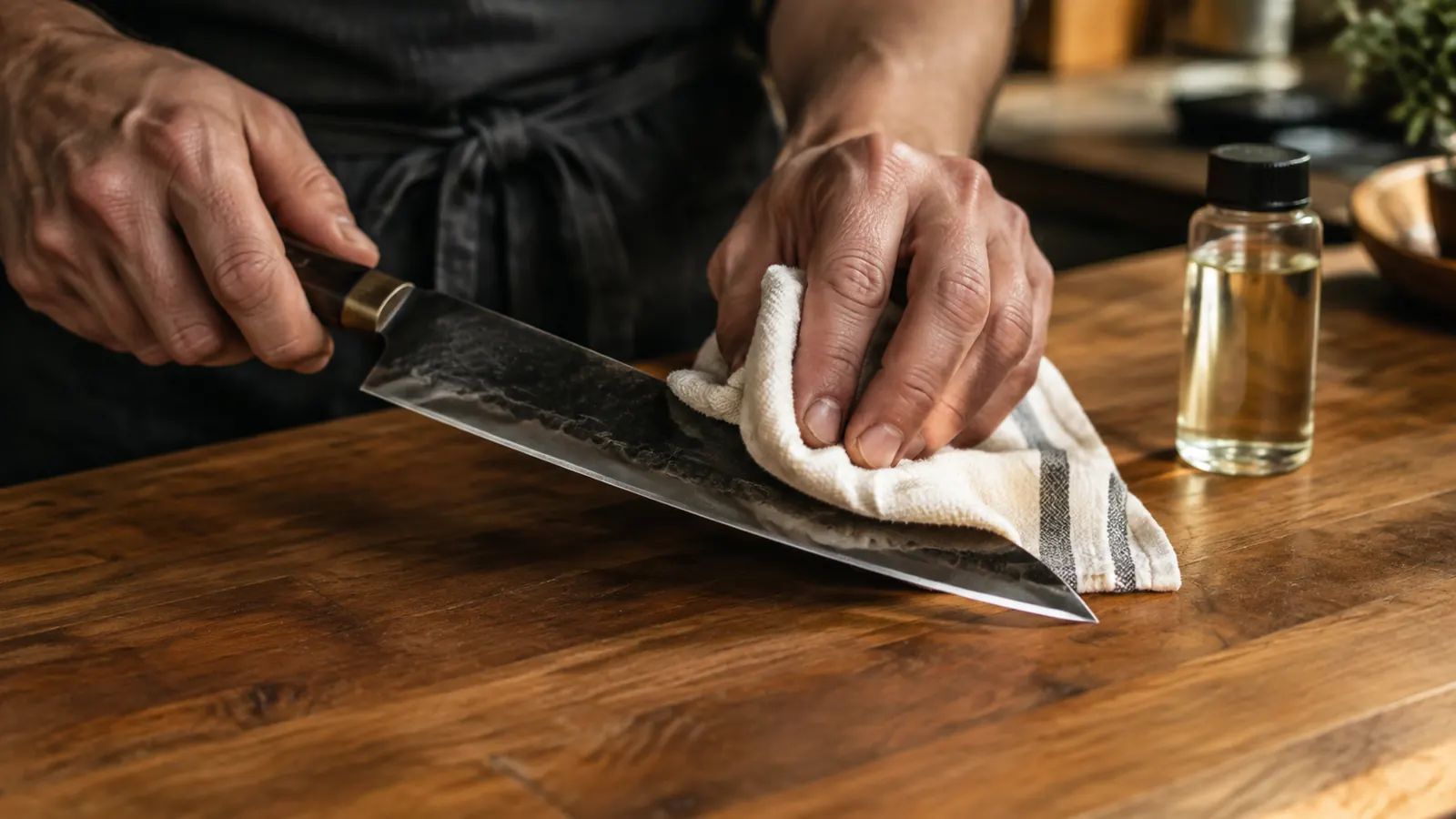
I want to put a number on the upkeep because everybody talks around it. Wash and dry immediately after use, which is maybe forty seconds a knife and only feels like an imposition when you are tired. A wipe of mineral oil on the blades if they are going to sit unused more than a week, which I do about once a month and which takes five minutes for the set. Stones every six weeks, which is a genuine half hour with the radio on. Call it three hours a year, plus never once leaving a blade wet.
That last part is not a time cost, it is a habit cost, and it is the one that actually decides whether a set like this is right for you. Three hours a year is nothing. Never once being careless is a different kind of ask. I have flown small aircraft since my thirties and the preflight walkaround is the same shape of discipline, so it suited me. I have watched it not suit other people at all.
What I Liked
- Cuts better than anything else in my kitchen, and it is not close
- The cleaver has real weight forward, so the knife does the chopping instead of your shoulder
- Takes a keen edge quickly once you learn the right angle
- Long slicer handles cooked brisket in single strokes instead of sawing
- Handles have stayed tight and taken oil well over eight months
Where It Falls Short
- High-carbon steel rusts fast if you leave it wet or let acid sit on it
- It will not look like the listing photographs after a few months, and that is permanent
- Needs stones every six weeks, and a drawer sharpener will not do
- Two of the four blades overlap enough that one mostly stays in the drawer
- Heavy and front-loaded, which does not suit every pair of hands in a household
Who This Is For
Buy the COOLINA set if you regularly bring home meat that is not already portioned. Whole chickens, pork shoulders, a hog share, deer season, brisket for the smoker. That is the work these are built for and the work where the difference is obvious rather than theoretical. Buy it also if you already keep your tools properly, because then the maintenance is not a new burden, it is just a few more items on a list you already run.
It also suits somebody who has decided to learn to sharpen. Carbon steel is honest feedback: you can feel the edge improve under the stone in a way that hard stainless hides from you. If learning that skill appeals to you, this is a good set to learn it on, and my only warning is the one about the cleaver angle.
Who Should Skip It
Skip it if most of your cooking starts with meat that came on a tray with plastic film over it. You will get very little back for the upkeep, because the jobs where these knives shine will not come up. A single good stainless chef knife will serve you better and forgive you more.
Skip it too if several people share your kitchen and not all of them will follow the rules. It only takes one well-meaning person putting a carbon blade in the dishwasher, or leaving it in the sink under a bowl, and you have a repair job instead of a knife. And skip it if you want a set that looks the same in five years as it did on the day it arrived, because that is not what this steel does.
Worth It If You Do the Work
Eight months in, the COOLINA Meat Lover set is the sharpest steel in my kitchen and the most demanding. If you break down whole cuts and you already look after your tools, it will change how that job feels. Have a look at what comes in the set and where the price sits today.
Amazon See the Set on Amazon →