
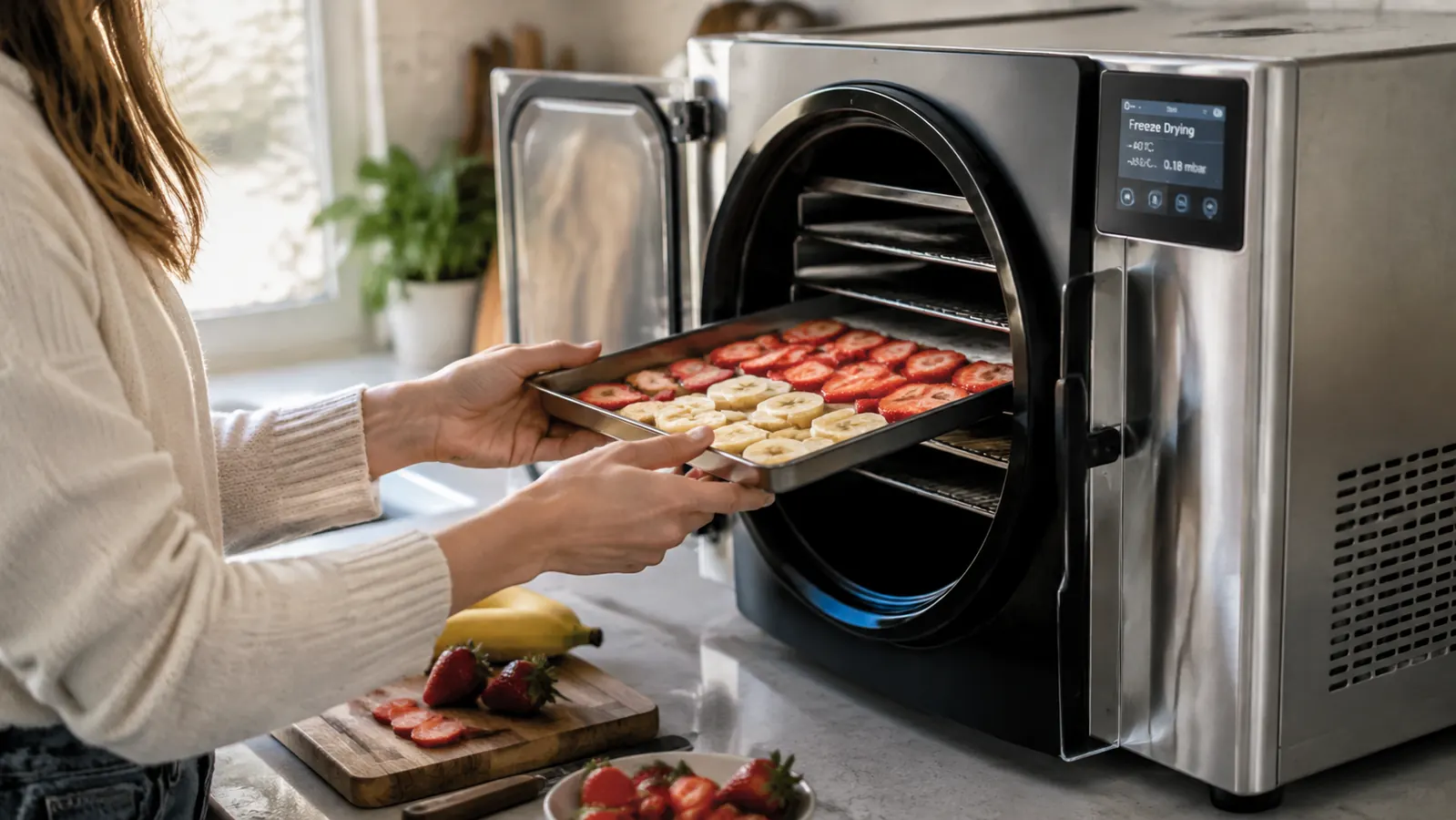
Every freeze dryer review starts the same way. The writer loads the trays, closes the door, and two days later pulls out strawberries that taste like they were picked that morning. That part is true, and I'll get to it. What nobody tells you is everything that happens between loading the trays and pulling the strawberries, because that stretch is where most of these machines go from exciting to exhausting.
I'm Ray Callahan. I've cooked seriously for about thirty years, I keep a small airplane in a hangar at the local field, and I treat my kitchen the way I treat my workshop: if a tool earns its space, it stays. The VEVOR vacuum freeze dryer has been on my counter for eight months and through nineteen batches. It stays. But it stays for reasons the product page does not mention, and those reasons are the review you're actually here for.
The Quick Verdict
It genuinely freeze dries food for a fraction of what the big names charge, but you become the maintenance department. Buy it with open eyes and it earns its place. Buy it expecting a set-and-forget appliance and you'll be disappointed.
Amazon Check Today's Price →The short version: it works, and it asks for work.
Nineteen batches in, I can tell you exactly what this machine does well and where it will test your patience. The honest breakdown is below, and today's price is worth checking before you decide.
Amazon Check Today's Price on Amazon →How I've Used It
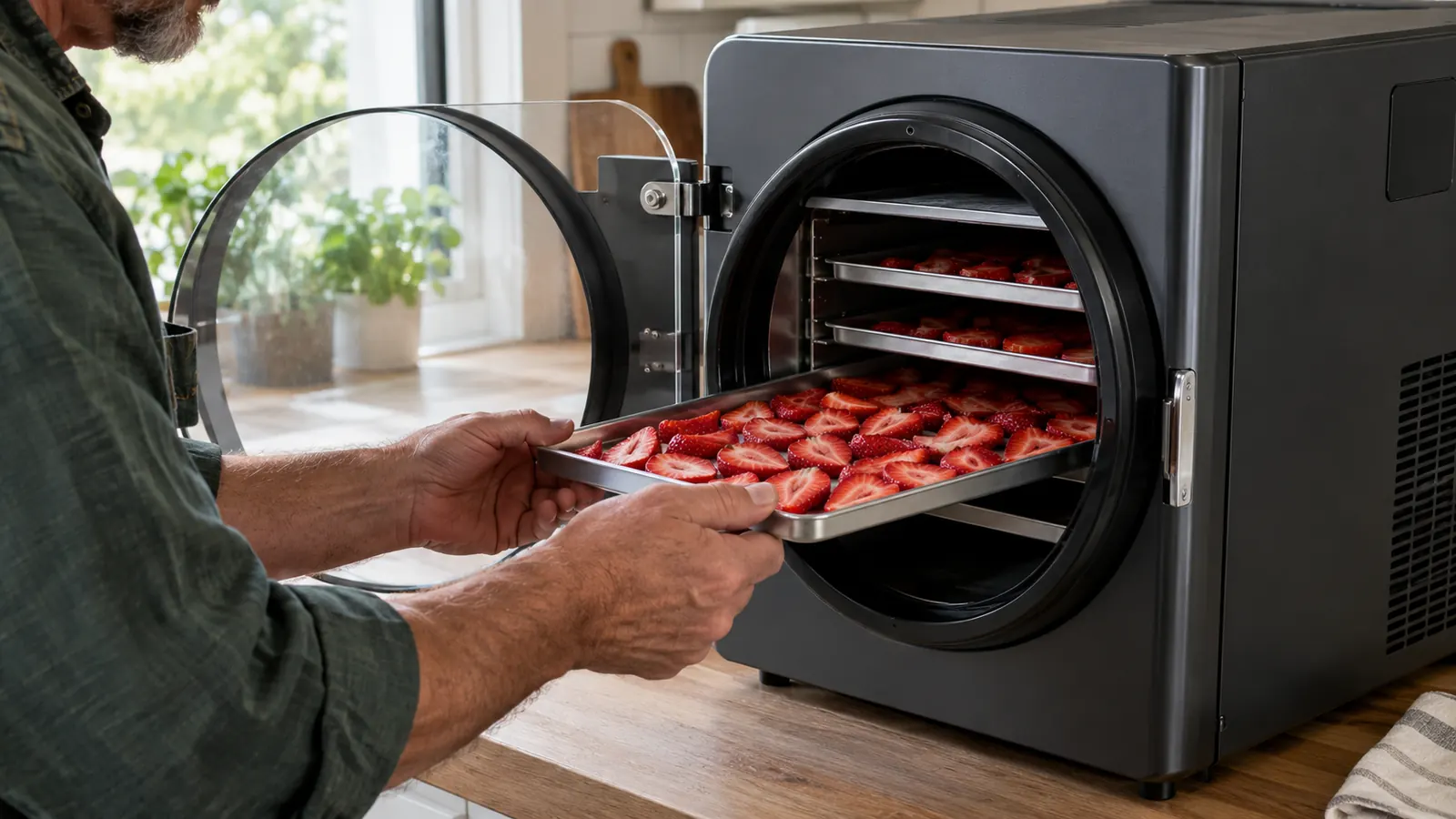
To be clear about the setup: the VEVOR sits on a section of counter I cleared for it, next to the back door. It's not a small machine, and it's not light. The trays are the four-layer stack from the listing, which sounds like a lot until you realize freeze drying shrinks food dramatically. I've put in garden tomatoes, peppers, eggs from the farmer's market, a big batch of chili, and a case of strawberries my wife brought home from the orchard. Nineteen batches total, ranging from a single tray of herbs to a full four-tray load of soup.
My neighbor Bill asked about it the week it arrived. He watched me run the setup routine, listened to the pump for about ten seconds, and said it sounded like the compressor on his old beer fridge. He's not wrong. That's the first thing nobody tells you: this is not a quiet appliance. The pump runs for the better part of a day and a half on a full batch, and it makes its presence known the whole time.
I keep a logbook, the same way I keep one for the airplane. Batch number, what went in, wet weight, dry weight, run time, how it rehydrated. That habit is the only reason I can give you real numbers instead of impressions. And the real numbers are the second thing nobody tells you: a batch is a commitment of time, not a chore you knock out in an evening.
The Pump Is the Part Nobody Warns You About
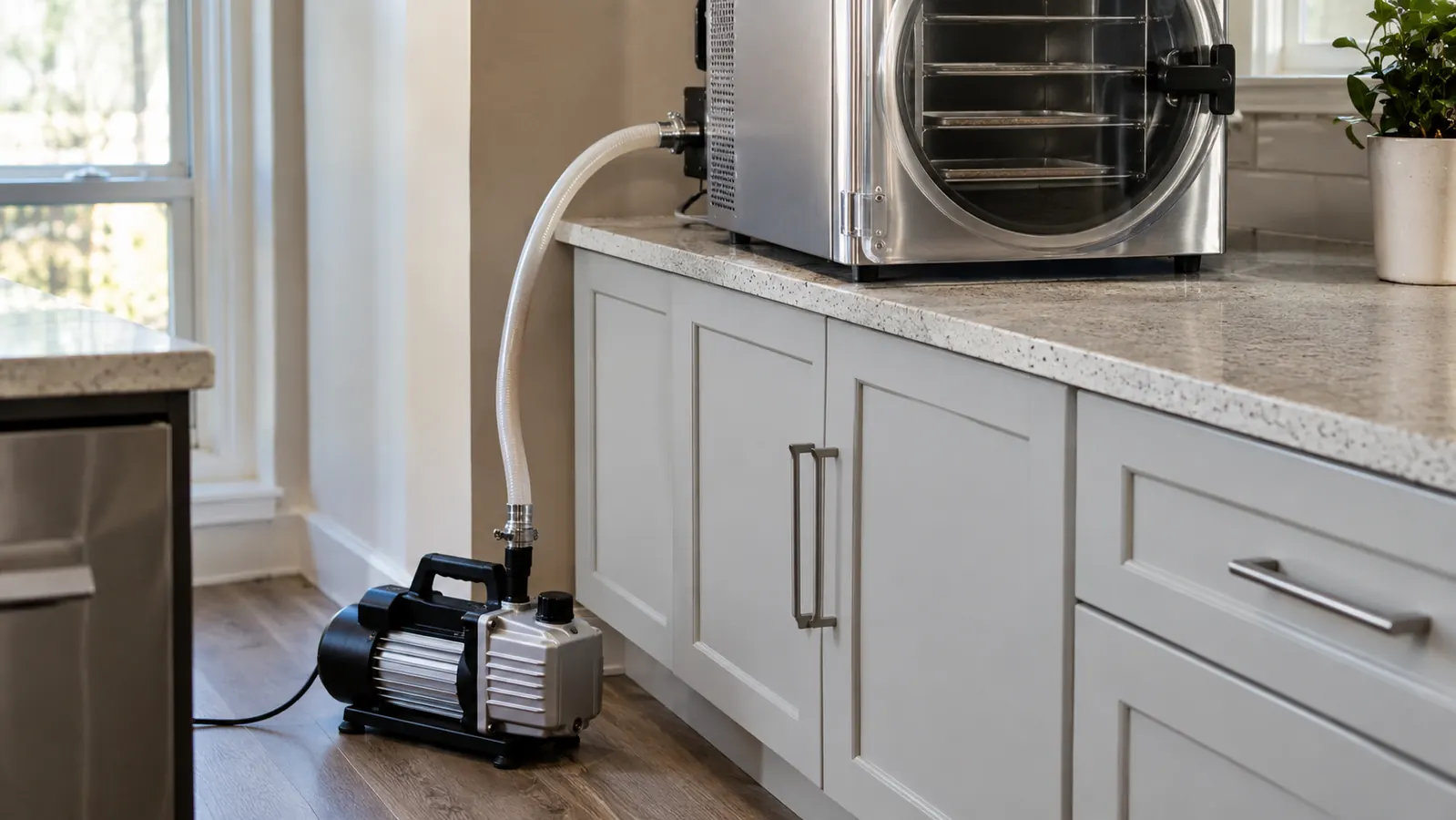
The vacuum pump is the heart of this machine, and it is also the part that will annoy you most. It sits on the floor, because it has to sit below the unit so oil can't run back into the lines. That means you give up floor space next to the cabinet, and it means the machine is really two machines connected by a hose. The pump needs its oil checked before every run and changed on a schedule, the same way I change oil in anything else that has a crankcase.
Changing the oil is not hard. You drain it into a container, wipe the sight glass, refill, and run the pump briefly to settle it. It takes about fifteen minutes and it is exactly as glamorous as it sounds. What nobody tells you is that you will do this more often than you expect, and that the oil is part of the ongoing cost of running the machine, right alongside the electricity and the desiccant packs you'll buy for storage.
The noise is the other half of the pump story. It is a steady mechanical drone, not deafening, but present. You will not want to sit in the same room for the full run. I've learned to start batches in the morning, because the first few hours are the loudest and the most active. Once the vacuum pulls down and the machine settles, it becomes background noise. But the word background is doing a lot of work in that sentence.
The hose and the drain are part of the same story. The pump connects to the machine with a hose, and the machine drains water through another line. You'll want both routed somewhere sensible before you start your first batch, because re-routing a hose full of water is a messy way to learn. I used a short length of tubing and a bucket, and I empty the bucket before it gets heavy.
What a Real Run Looks Like
Here is the timeline nobody puts on the box. You load the trays, and the machine freezes the food solid first. That takes several hours on its own. Then the vacuum pump pulls down, and the real freeze drying begins: the ice goes straight from solid to vapor, with no liquid stage in between. That sublimation phase is where the hours pile up. A full four-tray batch of something wet, like soup or chili, can run for well over a day. A batch of herbs or sliced fruit runs shorter, but still longer than a full night's sleep.
The machine decides when it's done, not you. There's a sensor and a window, and you learn to read both. The honest version is that you'll check it, think it's done, and find a tray of something that still feels cold and slightly soft in the middle. You put it back in for another stretch. This is normal. The first few batches are a learning curve, and the curve is steeper than the marketing suggests.
Batch size is the other reality check. The listing says 8.8 to 13.2 pounds per batch, and that number is the wet weight going in. What comes out is a fraction of that, because freeze drying removes water. My logbook says the strawberries went in at eleven pounds and came out at well under two. That's not a flaw. That's the entire point of the process. But if you're imagining filling shelves with the same volume you put in, adjust that picture now.
Eleven pounds of strawberries went into the trays. A single quart jar came out the other side, and it tasted like June in the middle of January.
What Comes Out the Other Side
The results are genuinely excellent, and I want to be clear about that, because this review is not a hit piece. Freeze-dried food rehydrates better than anything a dehydrator produces. The chili I ran through it came back as chili, not as a sad approximation of chili. The eggs scrambled like eggs. The strawberries kept their color and their flavor in a way that still surprises me, and I've been cooking for thirty years.
The shelf life is the real payoff. Properly sealed, freeze-dried food keeps for years, not months. I've got jars from the first batch still in the pantry, and they're as good as the day they came out. That's the reason this machine earns its counter space despite everything I've said about the pump and the noise. It's preservation, not just storage. A dehydrator buys you months. This buys you years. The longer pantry story on this site shows what that looks like over time.
Rehydration takes a little practice. Hot water works faster, cold water preserves more texture, and some things, like fruit, are best eaten dry. You'll ruin a batch or two while you figure out the ratios. I ruined part of a soup batch by adding too much water and turning it into broth. That's on me, not the machine. The machine did its job. The learning curve was mine.
Not everything is worth running through it. Mushrooms, berries, eggs, cooked meals, and most vegetables come out beautifully. Some things, like avocado or anything very oily, do not freeze dry well, and the machine will not tell you that in advance. You'll learn by doing. I keep a list of what worked taped to the side of the cabinet, and that list is worth more than the manual.
Where the VEVOR Cuts Corners
Now the part that makes this an honest review instead of a cheerleading post. The VEVOR is not a Harvest Right, and pretending otherwise helps nobody. The build quality is good for the money, but it's not premium. The control panel is simple to the point of being basic. The documentation is thin, and the translation reads like it was done in a hurry. You will figure some things out by trial, because the manual will not tell you.
Customer support is the biggest corner cut. With the big names, you get a phone number and a warranty process that feels like a company standing behind its product. With VEVOR, you get an email address and a hope. I haven't needed support, and I hope I don't, because I've read enough owner forums to know the experience is uneven. Buy from a seller with a solid return policy and treat the warranty as a bonus, not a promise.
The accessories are also on you. The machine comes with the trays and the basics, but you'll want extra trays, a good sealing system for storage, and desiccant packs. None of that is included, and none of it is optional if you want the food to actually last. Plan for that when you're deciding, not just for the machine itself.
The First Batch Is a Reality Check
My first batch was a half tray of sliced mushrooms, and it taught me more than any manual could. I loaded it, set the controls, and let the machine do its thing. Twenty-four hours later, the mushrooms looked done. They weren't. The centers were still cold and slightly rubbery, which is the signature of a batch that needed more time. I put them back in for another stretch, and that's when I learned the machine's real rhythm: it finishes when it finishes.
The other first-batch lesson was the water. Freeze drying pulls moisture out of the food and sends it down the drain hose. I had not thought about where that water goes until I watched it fill a container on my floor. It's a lot of water. A wet batch can produce more than you'd expect, and you need a drain setup that can handle it without making a mess. The manual mentions this. The manual does not emphasize it.
And the first batch taught me to plan around the machine, not the other way around. You cannot start a batch at noon and have food for dinner. You start it when you have a day and a half of runway. I now load batches on weekend mornings, which gives the run time to finish before I need the counter for something else. That planning is the real cost of ownership, more than the machine itself.
What I Liked
- Real freeze drying at a fraction of what the big names charge
- Four trays and a genuine 8.8 to 13.2 pound batch capacity
- Food rehydrates properly and keeps for years when sealed right
- Simple controls, no app, no subscription
- Standard pump design that's easy to service
Where It Falls Short
- The pump is loud and runs for a day or more per batch
- You own the maintenance: oil checks, oil changes, floor space
- Yield is a fraction of input weight, which surprises everyone the first time
- Thin documentation and uneven customer support
- Storage gear and desiccant are extra
Who This Is For
This machine is for someone who treats preservation as a project, not a convenience. If you garden seriously, if you buy in bulk when the market is good, and if you have the patience for a process that runs on its own schedule, the VEVOR will earn its space in what you stop throwing away. It's also for someone who doesn't mind maintenance. If you've changed oil in a lawn mower or a small engine, you're qualified. This is the same skill set.
It's for the person who wants the capability of a freeze dryer without the price of the big names, and who understands that the difference is mostly in the polish, not the result. The food that comes out of this machine is not a compromise. The experience of running it is where the compromise lives.
One more thing: this is not a machine you buy and ignore until you need it. It wants to be used regularly. The pump likes to run, the seals like to stay active, and a machine that sits for months develops its own problems. If you're the kind of person who uses a smoker twice a year, this is not your tool. If you're the kind who fills the freezer every harvest, it is.
Who Should Skip It
Skip it if you want a set-and-forget appliance. If the idea of checking oil before a run sounds like a chore, or if a machine that runs for thirty hours sounds like a problem rather than a process, this is not for you. A good dehydrator will handle most households, and it will do it in a single afternoon with no oil, no pump, and no learning curve. For most people, that's the right answer. The comparison between freeze drying and dehydrating on this site is worth reading before you decide.
Skip it if you're preserving occasional leftovers rather than real volume. The setup cost, in space and attention, only makes sense if you're running it regularly. And skip it if you need a company to hold your hand. VEVOR is a tool company, not a concierge. You get a solid machine and a thin manual. If that combination doesn't sound fine to you, spend the extra money on the big name and sleep better.
The bottom line: it's a real freeze dryer with real strings attached.
Nineteen batches in, I'd buy it again knowing exactly what I know now. If you're ready to be the maintenance department, check today's price and see where it lands.
Amazon Check Today's Price on Amazon →