

I read twenty-one thousand reviews before I bought a Lodge cast iron skillet, and every single one of them said the same happy thing: buy it once, it outlasts the house. Nobody told me what the first month would actually feel like. So here is the version I wish had been on that page when I ordered the 12-inch in November of 2024. It weighs more than you think. It heats slower than the expensive nonstick you are trying to replace. It will probably rust on you once while you are learning, and it will ask for two minutes of attention every day you own it. And despite all of that, I would buy it again tomorrow.
To be clear about who is doing the talking: I am a fifty-seven-year-old home cook, not a chef and not a food blogger. I cook six or seven nights a week for a wife who works late and a grown son who shows up on the porch hungry. My idea of a fun Saturday is a 1969 Mustang up on jack stands or a Cessna 172 doing a long cross-country leg. Both of those are mechanical objects with operating instructions, and a Lodge skillet is the same story. The day I stopped treating it like a pan and started treating it like a machine that needs to be understood, every problem I had been having with it disappeared.
The Quick Verdict
Heavy, slow to heat, and married to a two-minute daily routine. A year and a half in, it is still the most-used pan I own and I would buy it again. Just go in knowing what the weight and the heat signature cost you, and it rewards you exactly as advertised.
Amazon Check Today's Price →The Honest Version, Before You Spend a Dime
The Lodge 12-inch pre-seasoned skillet is the best-selling cast iron pan in the country because the physics are real. It is also five pounds of iron with a learning curve, and most reviews skip that part. Read the full breakdown below, then check today's price with your eyes open.
Amazon Check Today's Price on Amazon →How I've Used It
Since November of 2024 the Lodge has cooked somewhere north of four hundred meals in my kitchen, and I kept a notebook for most of them. Tuesday-night rib-eyes, Sunday cornbread, a three-hour braised chuck roast that stood in for a Dutch oven, and roughly forty pounds of breakfast potatoes. It has been to deer camp twice and sat on a Coleman stove in a snow squall. It rides in the back of my truck on race weekends wrapped in a bath towel, because it is the one pan that can sear for ten hungry people without ever dipping in temperature.
The pan it replaced got thrown away in March. Not because the nonstick coating wore out, exactly, it peeled off onto a piece of salmon and suddenly I was deciding whether I wanted to keep eating Teflon flakes out of a five-year-old pan. Whatever is on the Lodge surface is oil, polymerized by heat into a seasoning layer. It cannot peel because it is not bonded on, it is baked on, layer by layer, and it only gets better with use. That single fact is the real reason the review section reads like a fan club.
For the record, I measured what I could be bothered to measure. The pan is a shade over five pounds empty, closer to six with food in it, and the cooking surface is a genuine twelve inches across the top. The silicone handle holder that ships in the box is not a marketing extra. The bare handle will blister you in about four minutes on medium-high, and yes, I found that out the hard way on a Tuesday.
The Weight Nobody Warns You About
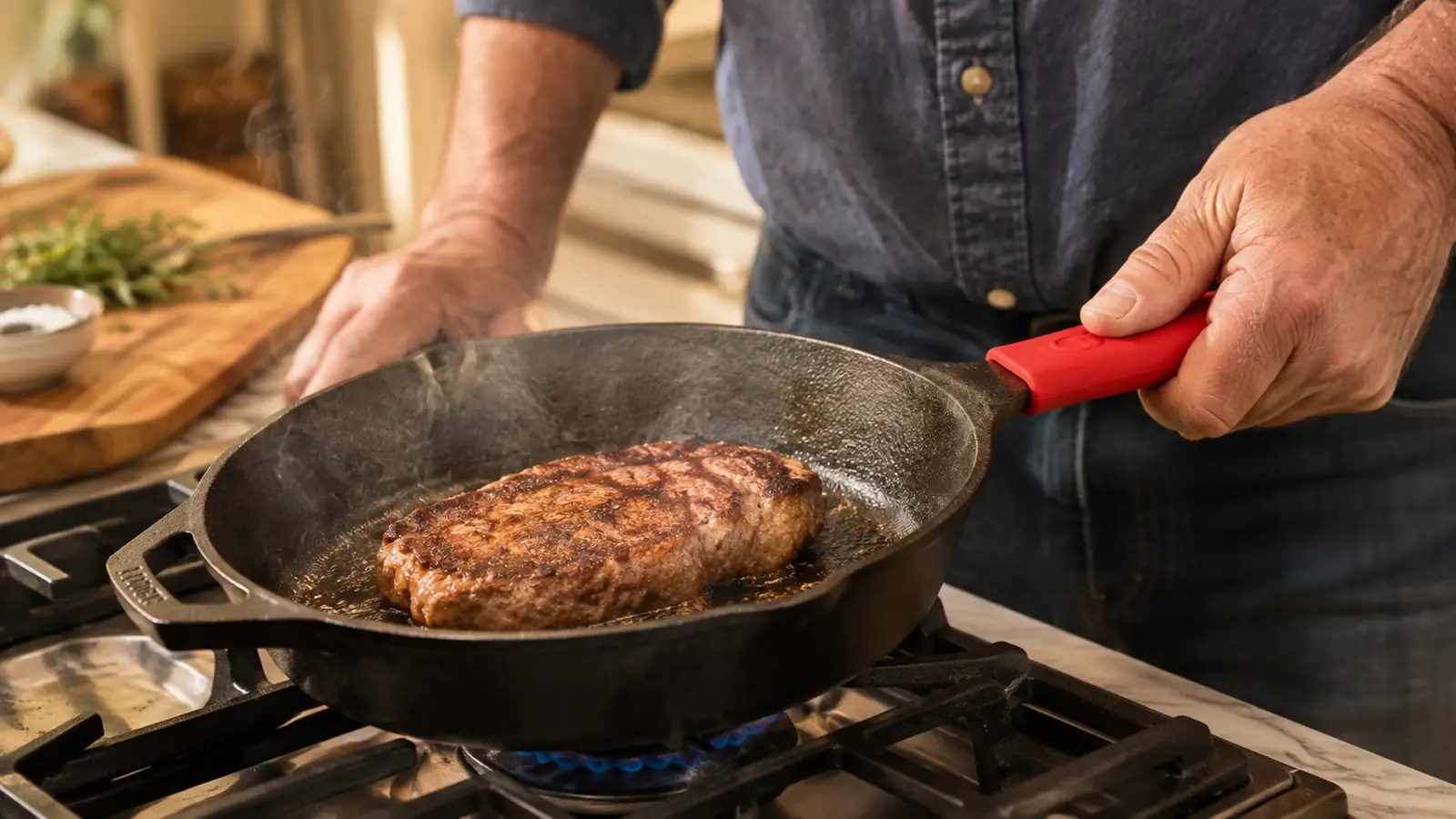
Here is the review nobody writes for you: the 12-inch is heavy. It is the heaviest pan I own by a wide margin, and the first time my wife went to flip a pancake she set it down and looked at me like I had brought a boat anchor into the kitchen. That is not cute, it is a real consideration. If you have arthritis, a bad shoulder, or a kitchen full of high cabinets where every pan gets hoisted over your head, the honest advice is to step down to the 10-inch, which is a far more manageable pan.
The weight is also the entire point, and it helps to understand that before you start resenting it. A twelve-inch slab of iron stores thermal energy the way a flywheel stores revs. That is why the pan sears and why a flimsy nonstick pan cannot. You are trading the ability to toss the pan around for the ability to leave heat on the food long enough to form a crust. Cookware is all tradeoffs, and the 12-inch is where that tradeoff is most honest and most visible.
My own reference point: I have spent twenty years around torque wrenches and disc brakes, so the weight equation made sense to me right away. Flywheels store energy, heavy brakes slow a car down hard and keep it cool while they do it. Your wrist will complain for the first two weeks while you recalibrate your grip, and then you will stop noticing the weight entirely and start noticing the sear, which is a fair swap.
Heat That Builds Like a Big-Block and Sheds Like One Too
The first Saturday I cooked on the Lodge, I heated it on high the way I had treated the nonstick pan for a decade, dropped in a pat of butter, and watched it smoke in about eleven seconds. That was my error, not the pan's. Cast iron has enormous thermal mass and zero manners about it. You cannot crank it up and pray. You preheat on medium for a solid five minutes before anything touches the surface, and then you let the pan tell you it is ready by the way butter behaves. This is the single most important thing to learn, and every review that skips it is doing you a disservice.
The payoff is the pan's reason to exist. Drop a room-temperature rib-eye onto a properly preheated slab of iron and the surface temperature barely dips. That is the difference between searing and steaming, and it is why a pan at today's price cooks a steak that tastes like it came off a restaurant line. The crust forms fast, the interior stays rare, and the whole process takes less than two minutes per side.
Now the part the ads leave out: cast iron does not shed heat on command. When you set the pan aside, the heat keeps working. Eggs keep cooking after you have killed the burner, and if you add butter to it the way you did on Teflon, you will brown it every single time. The pan has a personality and a pace, and it will punish you until you match it. If you have ever managed engine temperatures on a long climb, you already know the dance, and you will get along fine.
Seasoning Is a Routine, Not a One-Time Event
The Lodge ships pre-seasoned, and the box is honest: it will genuinely release an egg on day one, provided you have preheated properly and used butter. But that factory seasoning is a starting line, not a finish line. Around week six I made a pot of tomato sauce in the skillet, the way my grandmother made sauce in hers, and woke up to a gray sticky patch the size of my palm. I scrubbed it, oiled it, and moved on, no harm done.
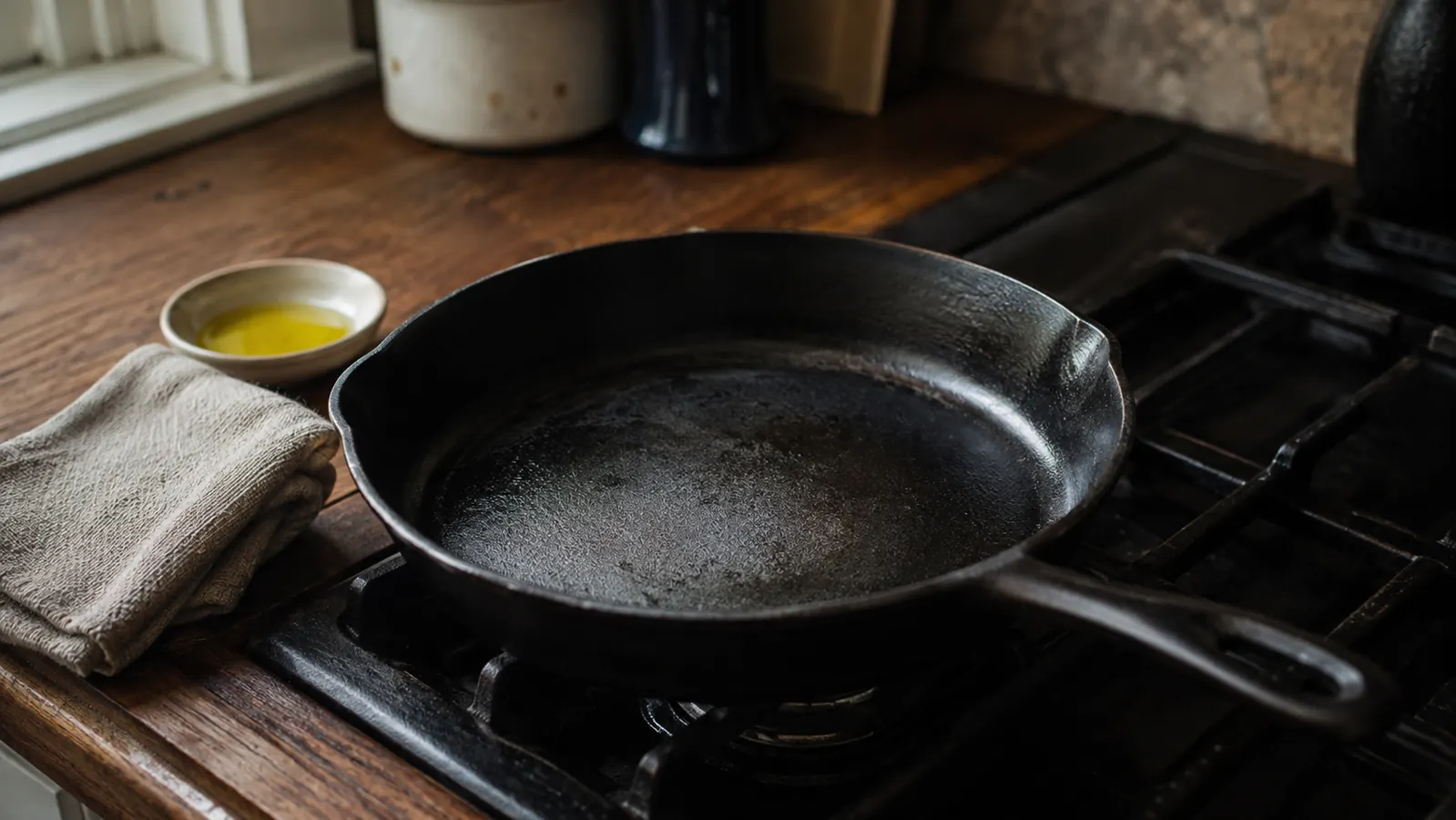
A month later I left the pan in the sink under a few inches of water for an evening. The rust bloom the next morning was the size of a silver dollar, and it looked exactly like the failure it was: my fault. Both of these were me breaking the one rule. Cast iron is maintained every single time you use it. Scrape it clean with a chain mail scrubber or a stiff brush, rinse with hot water, dry it on the burner until the water hisses off, then wipe in a coin-sized dot of oil and heat until it just smokes. That is two minutes, and it is the entire maintenance plan of the pan.
That routine is either the dealbreaker or the price of admission, and there is no wrong answer. The honest version of this review is that a lot of people will buy a cast iron skillet, love it for two weeks, then let it rust in shame because they did not want a pan that asks for daily attention. If you already know you will resent a two-minute chore, especially one that never ends, buy a different pan and do not feel bad about it.
Eggs, Acids, and the Dishwasher Rule
The dishwasher question comes up in every cast iron argument, so let me put it to rest: it is not a snob rule, it is chemistry. The long hot cycle with detergent strips the oil layer down to bare iron, and the moisture guarantees rust. A splash of modern liquid soap under a running faucet on a well-seasoned pan is fine, I have done it a hundred times and it never hurt anything. The dishwasher is a different animal entirely. It will not break the pan, it will just hand it back to you gray and angry, and you will spend a week re-seasoning it.
Acids are the other rule. Tomatoes, vinegar, wine braises, lemon, they all eat seasoning. And it is not just the pan that suffers, the acid picks up iron and makes the food taste metallic. Those ingredients belong in stainless steel or in an enameled pan. I kept my stainless saute pan for exactly that job, and in my cast iron versus stainless comparison I lay out the full division of labor, because every serious kitchen ends up owning both.
Eggs deserve their own paragraph because it is the test everyone runs first. A well-preheated, well-buttered cast iron pan will slide eggs like a good nonstick. An impatient one will glue them down and leave you scrubbing. The deep clean after a stuck-egg morning is the moment most people give up on cast iron, so if you are prone to impatience with breakfast, expect the first few Saturday mornings to be instructional.
Alternatives I Considered Before I Settled
My list had two boutique options on it, the lighter cast iron pans that cost five times as much. They are genuinely lighter and genuinely prettier, and I did not buy one because the weight savings comes from a thinner casting, and a thinner casting stores less heat, which is the entire point of the pan. It felt like paying a premium to get a worse version of the physics, and I am not in the business of doing that twice.
Enameled cast iron was the other serious candidate, because you get the heat retention without the seasoning routine. I own one enameled Dutch oven and I use it for braises and anything acidic. But the bare Lodge does two jobs enamel cannot do as well: it sears with a crust an enamel surface cannot match, and it goes from a stovetop into a campfire without me worrying about chipping the coating. For the money, one plain iron skillet and one enameled piece cover just about every job a kitchen actually has.
What I Liked
- Sear quality that beats pans costing far more, at today's price
- A non-stick surface with no coating that can peel, scratch, or flake off
- Goes from stovetop to oven to campfire with no limitations
- Buy it once and hand it down; the thing does not wear out
- Holds heat so steadily you can sear for a crowd without the temperature dipping
Where It Falls Short
- A shade over five pounds, and it never gets lighter
- The whole handle gets hot; the included silicone holder is mandatory
- Two minutes of cleaning and re-oiling after every use, with no exceptions
- Slow to come to temperature and slower to shed it, a real learning curve
- Tomatoes and vinegar strip the seasoning, so you still need a stainless pan
I stripped its seasoning twice and rusted it once in a sink of water, and tonight it still released a trout fillet without leaving a scrap behind. No other pan in my kitchen would forgive all three.
Who This Is For
Buy the 12-inch Lodge if you want the last skillet you will ever own and you are willing to maintain your tools the way you maintain everything else. The guy this is written for already owns a torque wrench and changes his own oil. He does not want disposable cookware, he wants serviceable cookware. If you sear meat, fry potatoes, bake cornbread on a Sunday, or cook at deer camp where the only power comes from a generator, this is the pan. It will outlive you, one of your kids will end up with it, and that is not nostalgia, that is what a slab of iron actually does. For the long version of that story, including the month-by-month wear, my full long-term review tracks every season I have spent with it.
Who Should Skip It
Skip the 12-inch if you cannot lift it one-handed, if your kitchen stores every pan in a high cabinet, or if the daily maintenance reads as another chore instead of ten minutes of caring for good equipment. Skip it if you mostly cook delicate fish and vegetables and want a pan that does not ask you to think about heat. And skip it if you are a confirmed dishwasher person. No judgment, different tool for a different life. There is a reason I keep a stainless saute pan on the rack next to this one. Cast iron is not for everyone, and the honest review ends right here: figure out which column you are in before you order.
The Honest Verdict: Worth It, If You Learn Its Rules
A year and a half in, the Lodge 12-inch is the most-used pan in my kitchen, and I would not trade it for any of the boutique options I considered. It asks two minutes a day and a little patience with heat, and it returns a sear you cannot get another way at today's price.
Amazon Check Today's Price on Amazon →