

I am 62 years old, I cook six nights a week, and I have spent my whole life treating kitchen knives the way I treat the spare ratchet set in the back of the truck at the track: keep buying cheap ones, keep losing them, keep telling yourself the next one will be different. It never was. Nine dollars or twenty, in my hands they all went dull in six weeks, and I blamed the cutting board, the steel, the grandkids, anyone but the knife.
I bought the Wüsthof Classic 8-inch chef's knife in August of last year. My son-in-law, who spent two years in restaurant kitchens before he got sensible and went back to school, finally put his foot down. "You complain about your knives more than you cook with them," he said. He was right. I priced it, I winced, and I ordered it anyway. This is the report on a full year of daily use, two weeknight dinners running and the big Sunday cooks in between.
The Quick Verdict
A heavy workhorse that holds an edge for months and still lands dead flat in my hand after a year of daily work. It costs real money, and it earns it back in prep time.
Amazon Check Today's Price →Tired of the cheap-knife cycle?
If you have been fighting dull blades and bruised knuckles for the last thirty years, this is the knife that ended it for me. See today's price and get the honest long-term picture before you commit.
Amazon Check Today's Price on Amazon →How I've Used It
Here is the honest scope. This is my only chef's knife. I do not rotate blades based on mood. On a normal week it preps two weeknight dinners plus Sunday lunch when the grandkids come over. I'm talking onions, peppers, garlic, a whole chicken broken down on Sunday, tri-tip sliced thin for sandwiches, and a pork shoulder cubed into half a dozen bags for the freezer.
So when I say daily, I mean daily. It has hit the wooden board, the plastic board, one unfortunate marble slab at my sister's house in April, and a stack of hard cutting mats that look like they survived a shop class. It has been wiped clean, honed, sharpened twice in twelve months, and dropped twice. It has never seen the dishwasher, and it never will.
My standard test is the tomato. Not a nice one, the mealy ones from the grocery store. A dull knife squashes a mealy tomato flat. Twelve months in, this knife still sits on the skin and drops through on blade weight alone. That one sentence is the whole review.
The one habit I had to learn was the steel. I had owned honing steels for years and never saw the point of them, because on a soft cheap blade they feel like a waste of time. On this knife they are the difference between sharpening twice a year and twice a month. Ten light strokes before each cook and the edge stays happy. It is not high-maintenance, it is on-time maintenance.
The knife also taught me better board habits without me noticing. With the cheap blades I used to scrape the edge into the board like it owed me money, because the edge was already gone. With an edge this alive, you stop doing that, and you reach for the flat of the blade to carry garlic to the pan. A good knife makes you a slightly better cook out of pure self-interest.
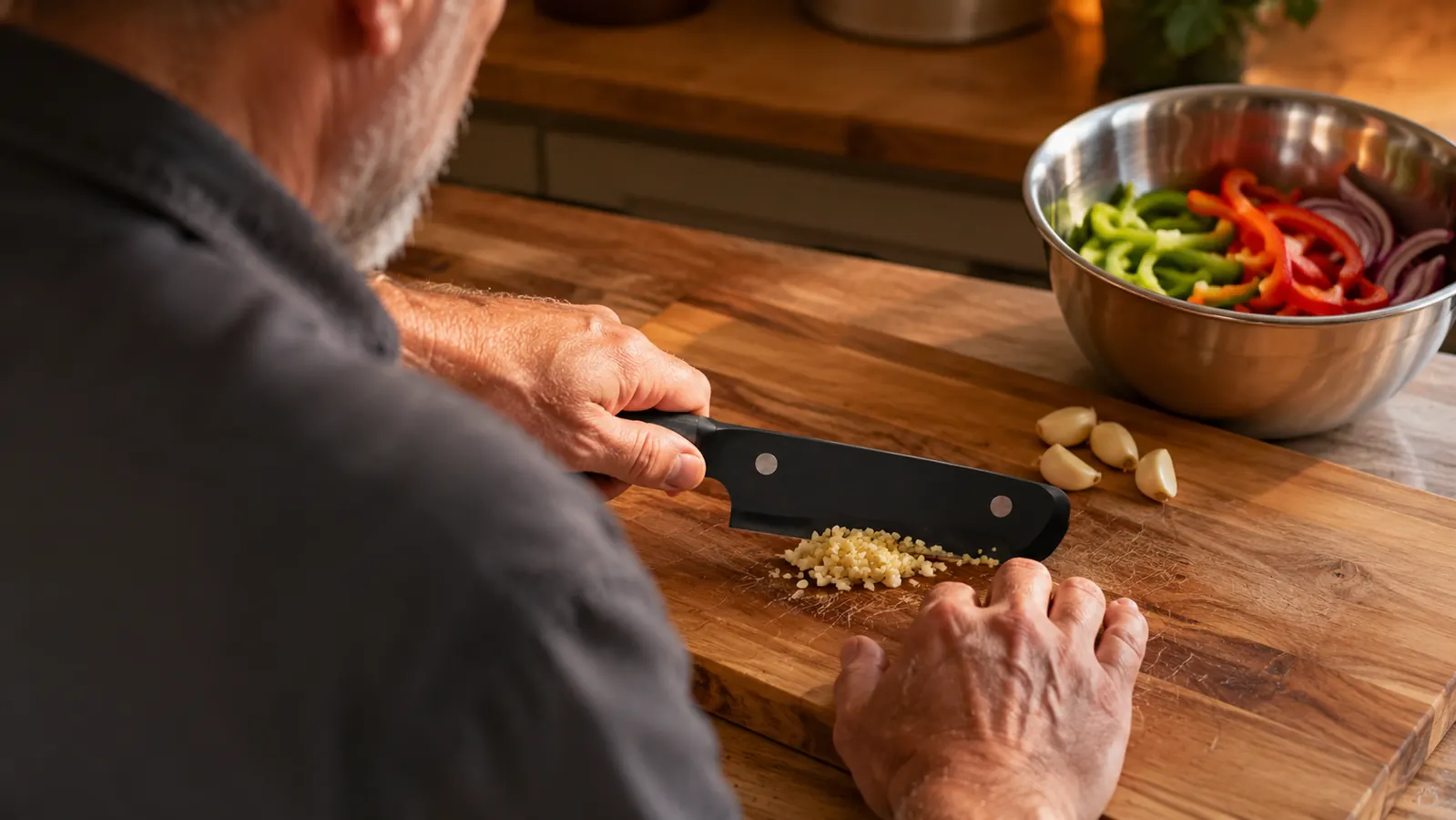
Edge Retention: The Number That Mattered to Me
Here is the spec sheet, kept short, because I want numbers not marketing. The blade is X50CrMoV15, the standard German high-carbon stainless, tempered to 58 Rockwell. The edge is laser cut to a fourteen degree angle per side. Wüsthof forges the whole knife from a single rod of steel, hot forged, not stamped, so the grain runs straight through the blade and back into the handle.
What that means in the kitchen: I honed it twice a week for the first two months and it never left genuinely sharp territory. Then I got lazy and honed once a week, and it still went six weeks between real sharpenings. On the cheap knives, a month between sharpening sessions meant a pull-through sharpener and bad language.
Let me put a real number on it. The last time I touched it with a stone was the first weekend of June, and as I write this in early August that same edge has broken down two whole chickens, a rack of pork ribs, and the better part of two weeks of evening vegetables. It is not razor sharp right now. It still cuts a mealy tomato without squashing it. A year ago, that sentence was about all I asked from a knife.
For the price-class skeptics I will add this: the spec sheet numbers are honest but understated about quality control. I checked the edge with a loupe the week I got it, looking for the rolled or chipped spots cheap knives tend to ship with, and found none. In a year it has never chipped, and I am not gentle.
The edge also comes back the way I like: gradually. A claimed-sharp budget blade snaps sharp and then dies fast. This one fades in a readable arc, so I notice a week before it becomes a problem instead of finding out mid-onion. Predictability is the quality I value most in a blade I touch six nights a week.
The Handle and the Full Tang
Grip is where every cheap knife lost me, because I have big hands and a load-bearing grip, and cheap handles flex under pressure. The Wüsthof Classic does not flex. The tang runs the full length, visible on both sides, and the three rivets tie the handle to it like it is part of a truck's front end. It has developed zero wobble in a year.
The balance point sits right at the bolster, where the handle meets the blade, which is where you want it on a German workhorse. That choice costs you, though: the knife is heavy, just over seven ounces. On a long Sunday cook you feel it. But it rides the board under its own weight, so push cutting and rocking through herbs uses the blade's heft, and your wrist does less.
The handle is POM, a hard synthetic resin, and I will give it to you straight. It does not absorb garlic smell the way smooth wood does, which I like. It also has none of the warmth of wood, and with wet or gloved hands it wants more grip than it gives. Bare and dry, it is a sure tool grip, exactly what the price is selling.
One more detail that grows on you: the spine is rounded and the grip shape is a soft trapezoid, so there is no sharp edge digging into your palm during a long rock-chop session. I can go through a full basil pile without a red mark, which sounds trivial until your hands are in their sixties.
Twelve months in, this knife still sits on the skin of a mealy grocery-store tomato and drops through on blade weight alone. That is the whole review in one sentence.
What It Won't Do
Here is what nobody tells you before you spend this kind of money. This is a German knife and it is built like a German car: reassuring, heavy, and happiest doing ordinary work extremely well. It is not a precision instrument. If you want to shave daikon into translucent sheets or carve garnish roses for fun, a Japanese blade and a set of stones is the better path.
The other honest ding is the bolster, that thick collar where the handle meets the blade. It feels great under the hand, and it blocks the stone from reaching the heel of the blade. The inch of edge right against the bolster has never been as sharp as the rest since month two. You can buy a wedge to correct it, or you can live with an imperfect heel. I live with it.
It also will not keep itself sharp, which I mention because the price tag has convinced half the neighborhood that steel never dulls. The edge is a thing you maintain, full stop. The difference with the Wüsthof is that the window for maintenance is long and forgiving. A cheap knife goes dull quietly and finds you at the wrong moment. This one drops in a straight line you can see coming.
And the money. Today's price is a serious outlay for a single knife, and you are paying for the forge, the three-rivet build, the brand, and a long guarantee. All of that is real. But if the budget is genuinely tight, the cheaper route still cuts food every day, it just dulls faster. Buy the math that matches how often you actually cook.

Alternatives I Considered
I did not walk into this blind. Before buying I compared it against the knives people actually pass around the restaurant trade: the Victorinox Fibrox Pro, the budget king, a mid-priced Japanese gyuto that a friend swears by, and a carbon steel blade from the same price bracket.
The Victorinox is the honest value pick. About a third of the money, light, genuinely sharp out of the box, and it is what I would recommend to someone who cooks twice a week. But it goes dull in roughly half the time, and the handle reads cheaper than it is. Six nights a week, paying once for the heavier blade is the arithmetic that wins. The gyuto is a brilliant cutter and I will never argue with an edge like that, but it wants stones, careful boards, and no bones. I break down whole chickens. That is exactly the job this knife shrugs at.
I also seriously considered a carbon steel blade, the kind that takes a patina and an almost scary edge, because I like tools that reward care. I ruled it out for the same reason I do not buy a race car for commuting: a carbon blade rusts if you look at it wrong, and I wanted a knife I can hand to my wife without a lecture. The stainless compromise is the right one for this house.
One thing I will say about the Wüsthof that nobody puts in the marketing: it does not care what else lives in your drawer. It does not need its own board, its own sleeve, or its own set of rules. It sits in the same rotation as everything else and outperforms it by such a margin that the other knives have honestly stopped getting picked up.
What I Liked
- Holds its edge for months between actual sharpenings; a weekly hone is enough
- Dead flat balance at the bolster, heavy enough to cut on blade weight alone
- Full tang with a riveted POM handle, nothing to flex or wobble, ever
- Handles whole chicken breakdowns and hard boards without chipping
- One knife for everything, covered by a manufacturer's guarantee for the long haul
Where It Falls Short
- Heavy for long sessions; you feel the seven-plus ounces in a Sunday marathon
- The bolster blocks the stone from reaching the heel of the blade
- Real money for a single knife; cheaper blades cut food too, they just dull faster
- Slippery handle when your hands are wet or gloved
So What's the Verdict After a Year?
Here is the honest summary I would give my neighbor over the fence. It is the only kitchen purchase in my adult life I would buy again without thinking, and I do not say that about appliances. Twelve months, roughly five hundred prep sessions, two drops on tile, and one thing I misplaced for three weeks. It still cuts the same as the week I bought it. If it died tomorrow, the replacement would be identical.
The reviews you read online lean on edge life and balance specs, and all of it is true. What a year adds is the unglamorous stuff: the heel that never quite matches the middle, the weight you notice at the ten-minute mark on a big prep, the steel that asks for attention once a week and rewards it. Buy this knife for the everyday truth of it, not the first-week romance.
Who This Is For
Buy it if you are the one who cooks, you are finished with dull blades, and you want to make this purchase once and stop thinking about it. Cook more than four nights a week? The edge life on this blade pays the difference within a year, and the manufacturer's guarantee means you will likely be the last person in the house who ever buys one.
Who Should Skip It
Skip it if you cook twice a month, your kitchen already has knives you love, or a heavy blade aggravates a weak wrist. And if you will never touch a honing steel, this knife dulls like every other blade on the planet, just slower. The Victorinox cuts fine at a third of the money. This is for the person who is done buying that knife over and over.
One more honest line. If you already own a Japanese knife you love, do not trade it for a German workhorse. Different tools for different jobs. The Japanese blade cuts circles around this one on light work, and this one shrugs at chicken bones the other should never see. Buy for the way you cook, not for the brand.
Still deciding after a year of honest use?
I waited thirty years to buy a real knife and spent them all fighting bad onions. If you cook daily, the Wüsthof Classic earns its keep fast, and the guarantee rides along for the long haul. Check today's price and make this the last chef's knife you buy.
Amazon Check Today's Price on Amazon →