
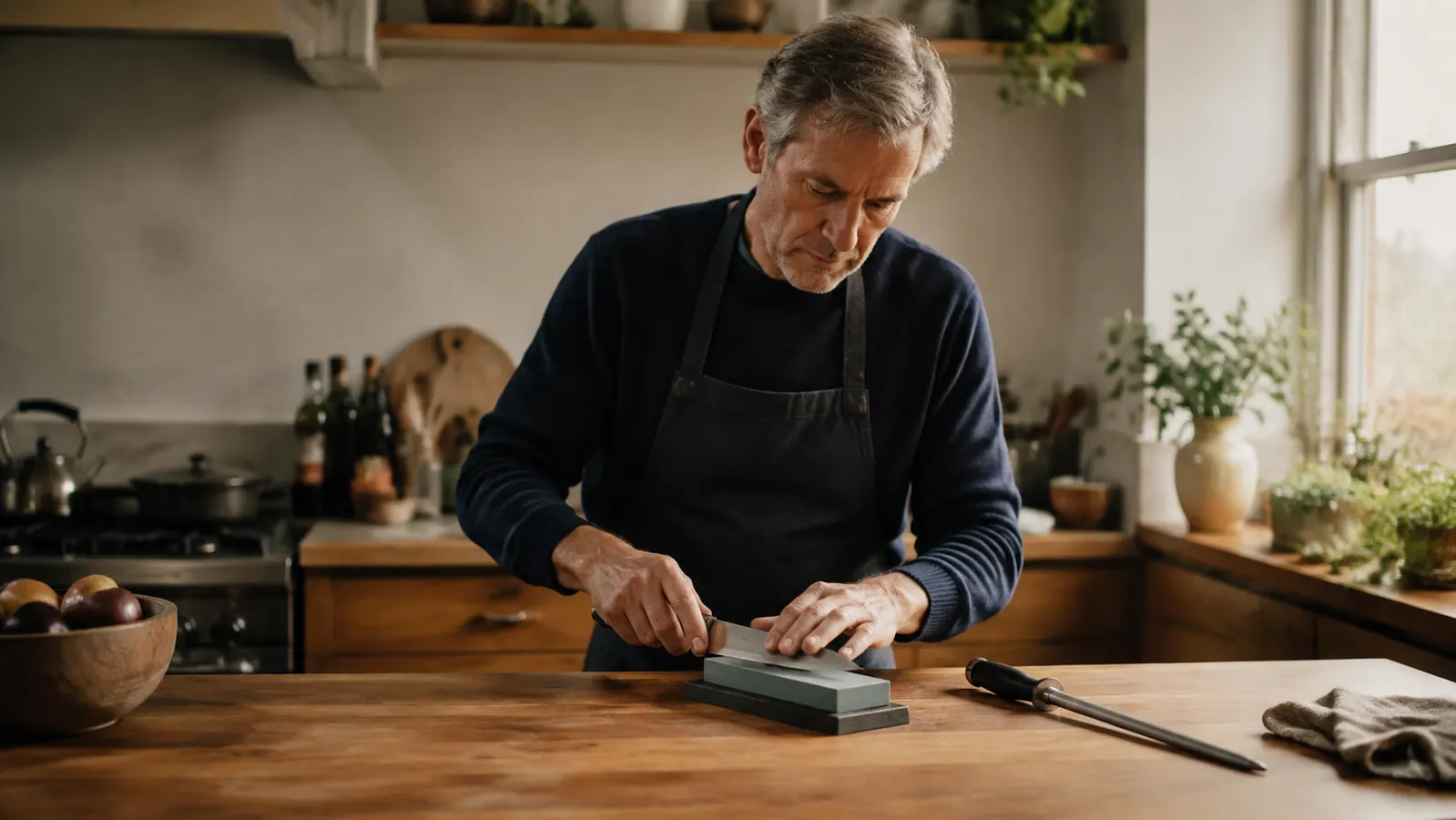
A dull knife is the most dangerous tool in your kitchen, and I don't say that for drama. You press a little harder on the tomato, the edge catches and skips sideways, and the next thing you know you're holding your thumb under cold water watching the sink run red. I cooked with a dull blade for years because I told myself sharp knives were a professional thing. Then I started treating my knives the way I already treat my truck before race weekend and the airplane before a flight: maintain on a schedule, and the tool never lets you down on the day that matters.
The whole routine is two moves and nothing more. Every time you take the knife out, you spend twenty seconds on a honing steel. Every couple of months, you spend twenty minutes on a whetstone. That's it, that's the entire syllabus. The routine only works if the steel underneath is worth the upkeep, which is why I run it on a Wüsthof Classic 8-inch chef's knife, the forged knife from Solingen. It holds an edge long enough that the stone comes out twice a year instead of twice a week, and it takes the edge back cleanly when it finally does. Keep a knife that dulls every few days and any routine becomes a chore, so start with a blade that has some endurance and the hard part disappears.
Start With a Blade That's Worth Maintaining
A common stamped knife loses its edge in a week, and no routine can fix steel that was never sharp to begin with. The Wüsthof Classic 8-inch is a forged, full-tang chef's knife that holds an edge the way a good tool should. It's the knife I run this exact routine on, and it's the last chef's knife I expect to buy.
Amazon Check Today's Price on Amazon →Step 1: Hone Before Every Cutting Session, Twenty Seconds Flat
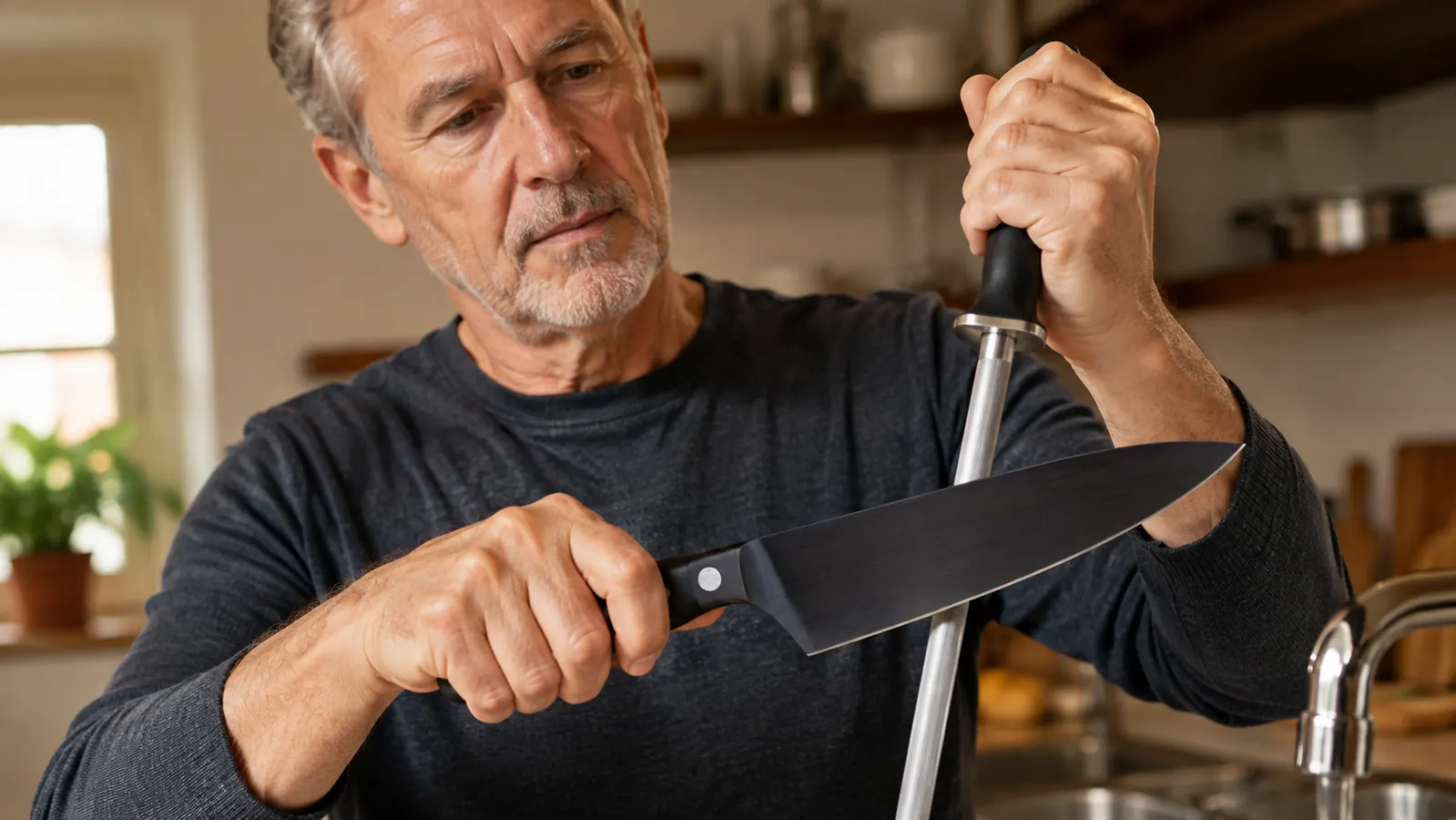
Honing is not sharpening, and that distinction is the whole trick. A steel does not remove any metal. It straightens the microscopic edge that folds over as you cut, the way every board and every tomato rolls the leading edge of the blade a hair out of line. If you start each session with ten light passes per side, the edge stays where it's supposed to be, and the knife keeps biting instead of skidding until something on the counter gives.
The technique is flat-out simple. Hold the steel vertically with the point resting on the counter. Rest the heel of the blade against the top of the steel at about 20 degrees, then draw the blade down the length of the steel toward you, sweeping from heel to tip. Ten passes on one side, flip the knife, ten on the other. Light pressure, steady angle, and no hesitation. You are aligning a hair-thin edge, not grinding a new one, and you cannot do it too often.
Here is the signal that matters. When a honing session stops bringing the edge back, the knife is telling you it is stone time. Do not double down on the steel. Once the edge is genuinely dull, honing just polishes a bent and tired edge, which is the worst possible version of doing nothing. The steel keeps an alive edge alive. It cannot resurrect one.
Step 2: Test the Edge So You Know When to Sharpen
You don't need to guess whether a knife is dull, and you don't need to buy a gadget to tell you. You need a fifteen-second check you can run at the counter without interrupting dinner. Hold the blade at a shallow angle and rest the edge lightly against a thumbnail, then try to slide it across. A sharp edge bites into the nail and stops. A dull edge rides right over it. Low angle, no force, and if it makes you nervous, test against the pad of a thumb instead. Either way it takes less time than finding the right setting on a knife block sharpener.
The second check is the tomato, and it is the one I trust most. A sharp edge parts a ripe tomato's skin under its own weight, no sawing, no real pressure, just the weight of the blade falling. A dull edge squashes the fruit first and then tears it. I run the thumbnail test every time the knife comes off the steel, and the day it stops biting, I know the whetstone is coming out that weekend rather than three months from now.
Step 3: Set Up the Whetstone, Once Every Couple of Months
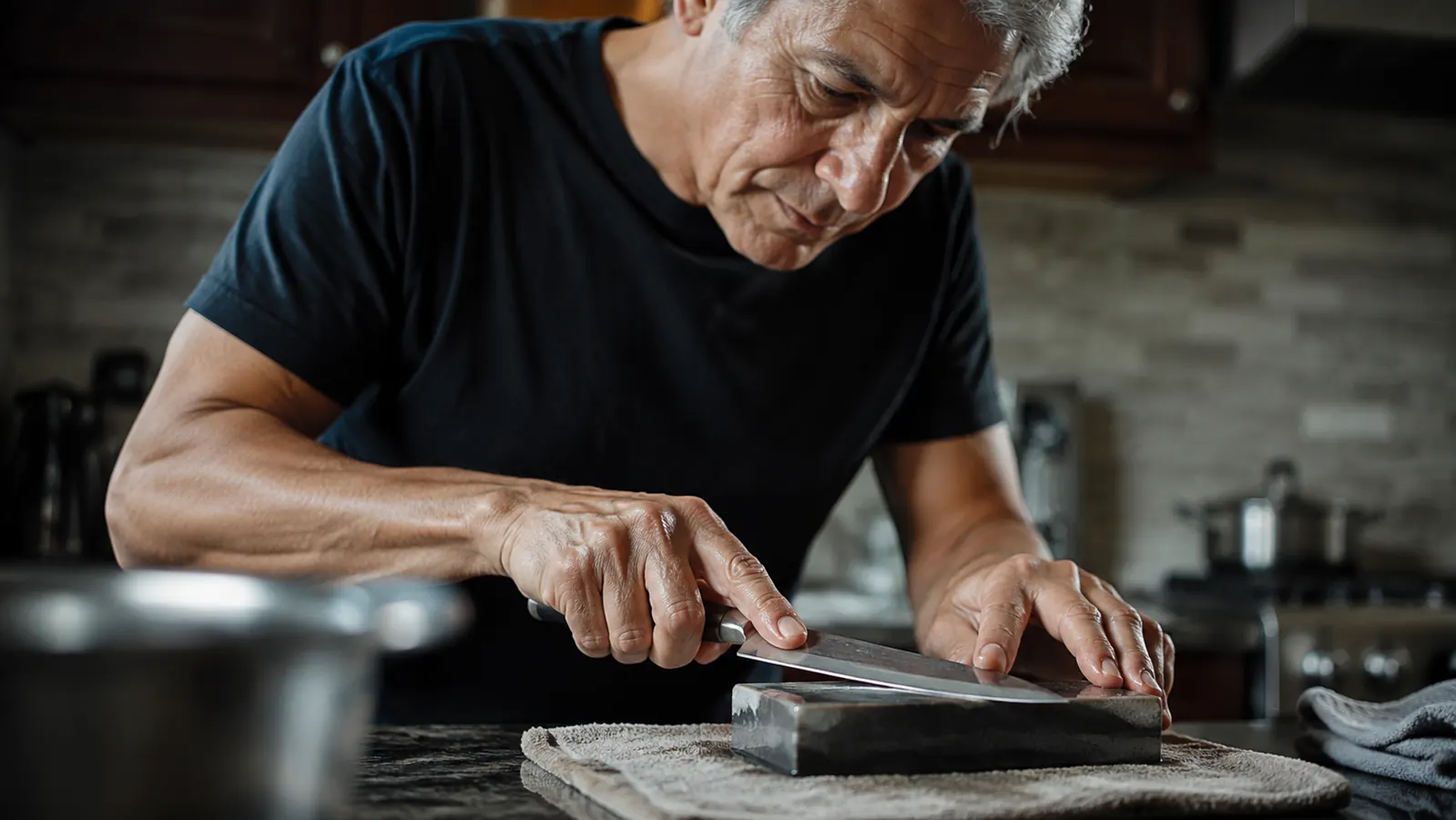
You need a combination stone with a coarse side around 1000 grit and a fine side from 3000 to 6000 grit. Soak it the way its maker tells you, usually around ten minutes, then set it on a damp towel on the counter so the stone sits dead still while you work. Coarse side up for the first round. This is the step that scares the most people, and it shouldn't. A stone is far harder to ruin than a knife, and a decent combination stone will outlast you.
Find the angle before you ever touch steel to stone. The Wüsthof Classic edge is ground at 20 degrees, the standard for German knives, a touch more forgiving than the sharper 15 degree edge you see on many Japanese blades. Lay the blade flat on the stone, then raise the spine until there is a gap about the width of two stacked coins. Hold that angle through every pass. If the spine side of the blade starts scraping the stone, the angle has drifted too steep, and you are grinding the edge away instead of forming it.
Step 4: Sharpen Edge First, Down the Coarse Stone
With the blade held at that 20 degree angle, draw it across the stone edge-first, from heel to tip, exactly as if you were trying to slice a paper-thin layer off the surface of the stone. Ten passes on one side, flip the knife, ten on the other. Keep the pressure light and even, about the pressure you'd use to remove a label. Wet the stone with a few drops of water every few passes, because once it loads up with fine metal dust it starts burnishing the edge instead of cutting it.
The way you know you are actually grinding steel, and not just polishing it, is the burr. After the first set of passes, run a thumb across the back of the blade, the side you have not been working. You'll feel a faint hook of metal, a catch that was not there before. That burr is the proof that both faces have finally met at a single edge. Now switch sides and grind the burr back off with the same count of passes. When you can no longer feel it on either side, the coarse work is done.
Step 5: Finish Fine, Deburr, and Put the Knife Back to Work
Flip the stone to the fine side and repeat the same edge-leading passes with almost no pressure at all, five or six passes per side. You are not cutting metal anymore; you are polishing the edge so it lasts, and you are chasing the last of the burr down to nothing. Finish with a few light passes on your honing steel, wash the knife by hand, and wipe the stone clean before you put it away.
Then run the thumbnail test again, right there at the counter. If the edge bites, you are done until the tomato test says otherwise. I keep one small habit that saves me from myself: a strip of tape on the stone's box with the date of the last sharpening. Knowing the stone comes out twice a year stops me from sharpening out of boredom, which is how good knives get worn down to paring knife size over a decade of well-meaning weekends.
What Else Helps (and What Will Wreck an Edge)
The cutting board decides half the edge's life, and nobody warns you about this. Wood or a soft plastic board gives under the blade and lets the edge cut clean. Glass, ceramic, and stone boards are the quiet killers: they fold the edge over with every stroke and undo everything above. If you hone faithfully and the knife still won't hold, look at the board before you blame the steel. I've seen the same knife go from dull in a week to dull in a season just by switching boards.
The second killer is the dishwasher, and it is just as easy to avoid. The heat, the detergent, and the rattle against other utensils beat a fine edge flat and can chip it. Hand wash, dry immediately, and store the knife on a magnetic strip or in a blade guard. Loose in a drawer, a good knife spends its nights sharpening itself against whatever happens to be next to it, and it keeps an edge about as well as you would expect.
Steel is the foundation, and this is where the Wüsthof earns its keep. The Classic line is forged from X50CrMoV15, a German stainless that takes a keen edge and holds it longer than most kitchen steel you'll find at a big-box store. That's precisely why this routine stays a routine instead of a part-time job. It is also why the knife stays for food. Bones, frozen blocks, and prying jobs belong to a cleaver or a pry bar, not to a blade that holds an edge this well.
One more thing said plainly. Nobody needs three chef's knives. If your money is tight, spend it on one good blade, a steel, and a stone, and skip the eight-piece block. A single knife that gets used, honed, and sharpened on schedule will outwork a wall of shiny knives that dull together and never get maintained.
The Routine on One Page
Twenty seconds a day, hone before every session. Fifteen seconds a week, run the thumbnail test. Twenty minutes every couple of months, coarse stone, fine stone, steel. That is the whole system, and there is nothing clever to it, no expensive gadget, no sharpen-in-thirty-seconds gimmick that actually works. The knives that stay sharp are the ones whose owners stay ahead of the dullness instead of fighting it from behind.
Honed before every use, my Wüsthof has needed the whetstone exactly twice in eighteen months.
A Twenty-Second Habit Needs a Knife That Cooperates
This routine is only as good as the blade underneath it. The Wüsthof Classic 8-inch chef's knife is what I've run it on for eighteen months, and it still parts a tomato under its own weight after the edge test says it's fine. If you want one knife you buy once, maintain in minutes a day, and keep for decades, this is where I'd start.
Amazon Check Today's Price on Amazon →