

I want to start with the number that never makes it into the ad copy. The Instant Pot Duo is sold as a fifteen minute meal machine, quick release, dinner done before the plates are warm. I kept a stopwatch on the counter for a full year, the same way I track lap times on race weekends, because I do not trust a gadget that promises speed and then hands you a timer. From a cold stainless liner to a sealed pot hissing at full pressure is routinely ten to fourteen minutes before a single recipe timer starts. Natural release on a pot roast adds another eighteen on top of that. The fifteen minute recipes in the booklet are closer to forty-five minutes before anything touches a plate.
That reads like a complaint. It is not. In that year I cooked ninety or so full pressure meals, plus dried beans, chicken stock, yogurt and a whole lot of chili, and the Instant Pot Duo is still the appliance I reach for first. What changed is my expectations, not the machine. A five star machine with 170,000 reviews will scorch your chili, spray your counter with sauce and make the kitchen smell like last week's dinner if you treat it like a microwave. This is the honest picture after fourteen months of daily use: the parts the reviews leave out, and the habits that turn those parts into non-events.
The Quick Verdict
Genuinely capable pressure cooker wrapped around an average rice cooker and a forgettable app. Learn to deglaze, seat the ring and skip quick release on anything saucy, and it earns its counter space every single week.
Amazon Check Today's Price →It does more per square foot of counter than anything else I own
Fourteen months in, mine still seals tight and cooks to temperature every week. The quirks are manageable and the payoff is real. See what the Duo is going for today and decide with the full picture in front of you.
Amazon Check Today's Price on Amazon →How I've Used It
A used machine tells you more than a spec sheet, so here is the log. Most weeks it is dried beans: two pounds of pintos at about forty minutes of pressure after a quick soak, then a long rest on keep warm while I brown onions and garlic in the same liner. Sunday is chuck roast: a seven minute saute to sear every face of the meat, a deglaze with beef broth, sixty minutes at high pressure and eighteen minutes of natural release. Chili twice a month. Yogurt on alternate weekends. Hard-cooked eggs by the dozen with the 5-5-5 method. Chicken stock from two carcasses whenever the freezer fills.
The saute function is the credit nobody gives this machine. I brown meat, sweat the aromatics and build a fond, then deglaze and switch straight to pressure without dirtying a second pan. That single feature is why the Duo lives on the counter instead of in a cabinet. The delay timer does real work too: beans set the night before are ready when I walk in from the hangar at six, and the keep warm mode has held a finished stew for two hours without drying a thing.
The app I am cooler on. Eight hundred recipes is a library, not a reason to buy, and I use it like a reference table rather than a cookbook. The pressure, saute and keep warm functions on the machine itself are where the money goes. The smart features are a nice-to-have, and on a counter appliance I would rather see the budget spent on the seal and the sensor, which is exactly where Instant Pot put it. And the steamer basket that ships in the box earns its keep at least twice a month: collard greens on the trivet with a cup of water under them, three minutes under pressure, and they come out bright instead of cooked to death. It is the only accessory I reach for regularly, and it costs nothing extra.
The Burn Code Is Real, and So Is the Fix
I hit it in week one. Thick chili, forty minutes planned, and at about halfway the screen lit up with Burn and the element shut down. The chili survived, the machine was fine, but I had to understand what the sensor was actually seeing. When anything starchy or tomato based sits against the liner bottom while the pot climbs to pressure, it scorches. The sensor reads a scorched bottom as a dry bottom and stops heating rather than risk a hot spot on the stainless.
The fix became a habit after one ugly Sunday. After any saute step, deglaze the liner, scrape everything off the bottom and seal it clean. Add dairy and any cornstarch slurry at the end of the cook, never the start. Since I wrote that rule into my routine, I have not seen the Burn code again, except for the single cook where I skipped the deglazing because I was in a hurry. There is a pattern there worth noticing.
If your Duo keeps throwing Burn on tomato or dairy dishes, it is the sequence, not the unit. Forty five seconds of scraping and deglazing turns the complaint hiding under all those five star reviews into a non-event. This is the single most useful thing I learned in the first month, and it is the thing no product page will tell you.
Quick Release: Best Feature, Messiest Feature
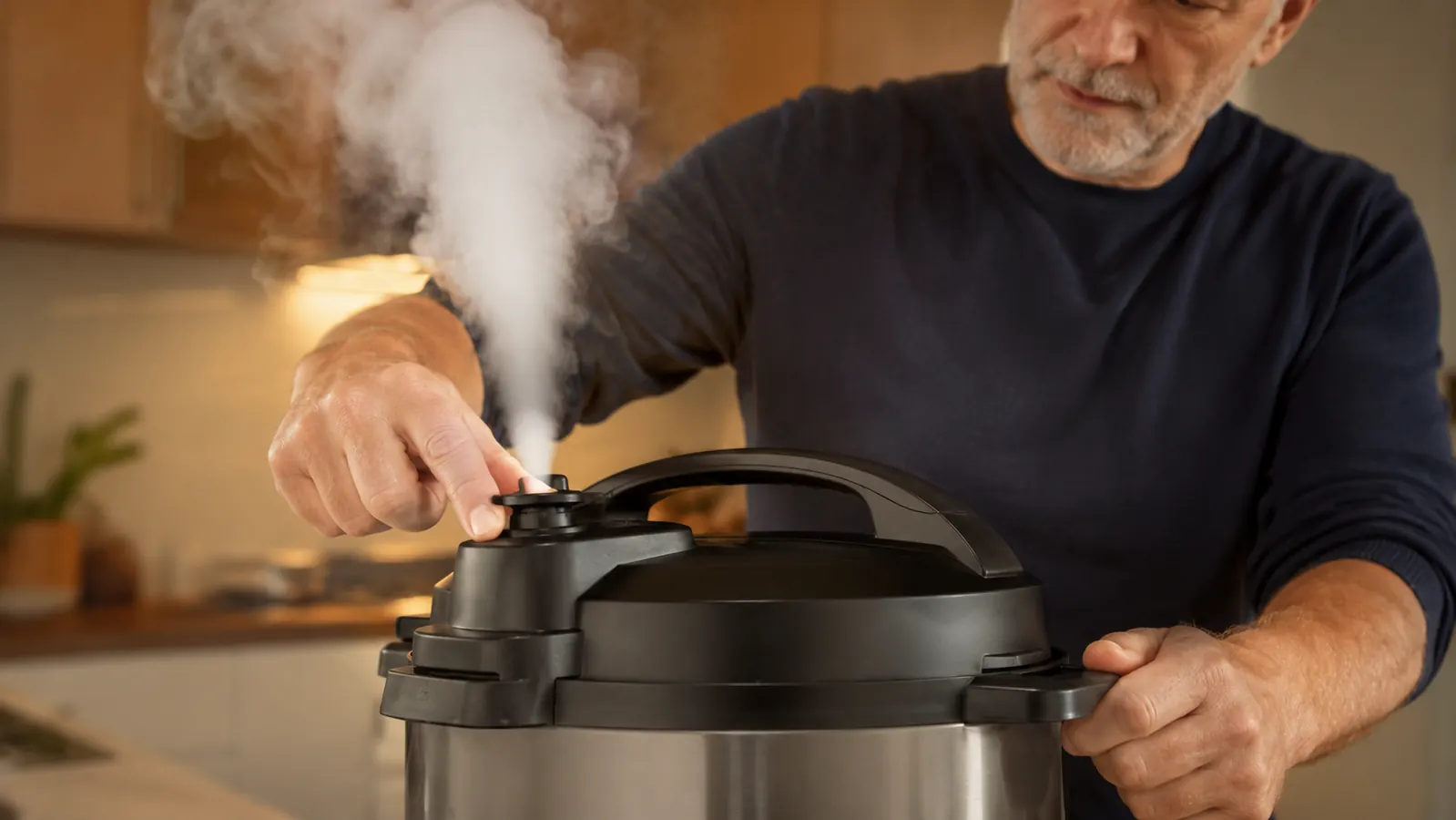
Quick release is brilliant for anything solid. Chicken, eggs, ribs, food that does not foam. Flip the lever, steam blasts out of the vent, the lid shudders, and seconds later you are carving. For anything with body, it is a physics demonstration you then have to clean up. Liquid inside a sealed pot sits at 15 psi, which means it boils far above the 212 degrees the kitchen treats as boiling. The instant pressure drops, that superheated liquid flashes to steam and rides the vent right out of the valve, taking sauce with it.
Apple sauce was my teacher. Saucy chili a close second. I have wiped the mess off the lid, the vent cap, the wall behind the machine and the handle of the spoon in my own hand. It takes one tailgate-sized soak of the countertop to learn the rule: quick release only for solid cuts, full natural release for anything saucy or starchy.
Natural release costs you nothing, because it is hands off. You walk away, come back when the float pin drops, and open a lid that has not redecorated your kitchen. And treat the vent with respect: this is real steam at real pressure, not a tea kettle's. The standing rule in my house is hands and faces off the lid until the float pin is down, and that goes for curious grandkids too.
The Sealing Ring Will Smell Like Last Week's Dinner
The silicone sealing ring is the dirty secret of this machine. It does the actual sealing, it lives in a groove under the lid, and it soaks up odor like a sponge. By week three my ring smelled like chili when the pot was empty and the lid was open on the counter. The people at Instant Pot know their own product: they sell spare rings separately and cheap, which is the company quietly telling you to own more than one.
The fix is two rings and a rotation. One ring stays on savory duty, beans, chili, stock. The other handles rice and yogurt, where a chili-flavored batch of yogurt would be a crime against breakfast. Most weeks my cleaning is a top rack run in the dishwasher. When the smell gets ahead of me anyway, I steam a halved lemon in the pot for three minutes with the ring seated in place and it comes out neutral.
And seat the ring before every single cook, every time, the way a pilot runs the same preflight check before every flight. A ring sitting crooked means the pot hisses and never pressurizes, and you stand there wondering why beans took an hour and a half and still came out crunchy. That was my week two lesson, and it is the most common real complaint hiding under that wall of five star reviews.

Pressure Time Is Not Dinner Time
Here is the math the recipe cards skip in the interest of selling something. A fifteen minute pressure recipe needs about ten minutes to come up to pressure, then the natural release the recipe quietly assumes on top of the timer. My stopwatch says the famous 5-5-5 egg method is closer to twenty five minutes from a cold pot, and a pot roast recipe that prints 60 minutes is really an hour and a half door to door.
There is nothing wrong with that once you know it. This is batch cooking hardware, not speed hardware, and the food comes out better for it. Beans and tough cuts do not care if they wait an hour on keep warm, so I load the pot, set the pressure time, let it release naturally and pull dinner whenever I am ready for it. Plan around the clock instead of arguing with it and the Duo stops disappointing anyone, including the cook who was promised fifteen minutes.
Rice is the single dish I still time carefully, because rice goes from perfect to paste in about four minutes and the natural release is part of the recipe, not a suggestion. I measure by the cup, rinse until the water runs clear, then do not touch the lid again until the float pin drops, because fussing with rice has never once made it better. Everything else happily waits. That is the real value proposition of the Instant Pot Duo: a machine you set well before you are hungry, that holds the results until you are. Buy it for that, not for the timers printed on the recipe cards.
The recipe card said fifteen minutes. Cold pot to first fork-tender bite, stopwatch in hand, was forty-six. That is the number the ads leave out, and it is a fair trade once you plan around it.
Cleaning and the Long Haul
The stainless liner is dishwasher safe and I treat it as such, because a chili machine that demanded hand washing would not survive my house. The lid is the part to be careful with: I wash it by hand at the sink, ring out to the top rack, then a rinse under the tap. Fourteen months in, the liner looks like new steel and the exterior wipes clean with a damp cloth. This is where the stainless build earns its keep over the enameled budget machines.
Two maintenance habits keep it honest. The condensation cup on the back collects drips from the lid and will look like its own ecosystem if you ignore it, so it gets a rinse whenever I start a cook. The vent cap twists off for a soak when the steam starts coming slow, which has been about twice a year for me. That is the whole maintenance list. A two ring rotation and a cup rinse, and the machine keeps sealing and cooking like it did in month one.
One more thing the manual buries: the anti-block shield, a little metal cage on the underside of the lid that keeps food out of the steam vent. It does its job, which means it catches a fair amount of what you cook. If the pot ever struggles to reach pressure, or the steam comes out weak, that shield is usually the culprit. Mine comes out once a month, soaks with the vent cap, and slides back in dry. Two minutes of maintenance keeps the seal fast, and the fast seal is the whole point of the machine.
What I Liked
- Set and forget pressure mode turns dried beans, tough cuts and stock into hands off dinners
- Saute in the same stainless liner, then deglaze and switch to pressure: one pot from fond to finished
- Builds pressure fast and holds temperature steady, no flame watching and no gauge babysitting
- Slow, rice, steam and yogurt modes share the footprint of a single appliance
Where It Falls Short
- Burn code on anything tomato or dairy unless you deglaze first and thicken last
- Quick release sprays saucy liquid through the vent, lid redecorating required
- Sealing ring soaks up odor within a few weeks; budget for spare rings
- Recipe times ignore come-up and release, count forty five minutes where it says fifteen
- The lid takes up its own counter real estate, there is no hinge
Who This Is For
Buy the Instant Pot Duo if you cook beans, tough meat or stock on any kind of schedule, if you want one machine that retires both a slow cooker and a rice cooker, or if you are the type who will spend one Saturday learning a tool so it does a decade of work without drama. The quirk list takes exactly a week to learn: one burned chili, one spew, one ring rotation, and then it is done. That is a short apprenticeship for the most useful appliance I own.
It fits the way I actually cook, bulk on Sunday and reheated all week, no takeout line at six o'clock. It fits a guy who would rather watch a race than babysit a pot. If that is your kitchen too, buy it once, learn its three habits, and stop looking at other pressure cookers. I wanted to be told what to buy and why, once, and this is the one.
Who Should Skip It
Skip it if you cook for one and already resent washing lids, or if a dedicated rice cooker plus a big Dutch oven already covers your weekly habits. Skip it if you know yourself well enough to admit you will never deglaze, because the Burn code will return every single time and you will end up hating the machine for your own shortcut. The Duo is not a microwave, and the reader it serves best is the cook willing to learn it.
And measure the counter before you buy. The six quart is a real footprint, and the lid needs its own resting spot beside it. If the counter is the thing you are protecting, a stovetop pressure cooker or a plain slow cooker might be the honest answer instead. I would still tell a friend to buy the Duo. I just would not let them buy it blind, which is exactly what this review is for.
Read this far? Buy it once, learn its three habits
Fourteen months and ninety cooks in, I would order the same machine again tomorrow. The ring smell, the spew and the burn code are all manageable, and the payoff is beans, stews and stock on demand. Check today's price with the honest picture in hand.
Amazon Check Today's Price on Amazon →